Offering a New Online Master’s Degree in Computer Networking and Administration

Southeastern’s Department of Computer Science is now offering a master of science degree in computer networking and administration. Delivered exclusively online, the program is designed to address the widening skills shortage in enterprise-scale networking, including cybersecurity and system administration, and follows best practices needed for the workforce.

Computer Science Interim Department Head and Instructor Bonnie Achee said the degree prepares students for positions such as computer network administrator, network specialist, network design engineer, system software developer, and system administrator.

“We are proud to offer a 100% online master of science in computer and networking administration,” said Achee. “This cutting-edge program will serve both recent graduates and industry professionals who seek to advance or transition to a career in systems administration, high-performance computing, and systems security, to name a few.”

Coursework is offered every fall, spring, and summer, ensuring students can graduate in a timely manner, Achee explained. Hands-on labs are also provided through online services, giving students 24/7 access to state-of-the-art computer networking and administration labs.

For more information, email mcna@southeastern.edu or visit southeastern.edu/mscna.

Deploying Buoys for Monitoring Project

Southeastern deployed four buoys this week for the independent, scientific monitoring of the Lake Maurepas ecosystem as part of its Memorandum of Understanding (MOU) with the Federal Government and with Air Products’ work on its Louisiana Clean Energy Complex.

“These buoys will provide data that the public can trust about the Lake Maurepas ecosystem since that data is coming directly from the lake itself. Independent monitoring of the lake is critically important to the community and all those people who live and work there,” said Louisiana Clean Energy Complex Commercial Executive Director Danna LeBlanc. “We know Southeastern researchers are the leading experts on Lake Maurepas, and the Air Products team is proud that they are able to expand their independent biomonitoring research by using these buoys.”

Southeastern will gather baseline data within the aquatic and wetland realms prior to the initiation of any future carbon sequestration projects in Lake Maurepas. An essential component of the project will be extensive environmental monitoring of the Lake Maurepas region, so that any impacts of the project can be understood and data be made publicly available.

“This demonstrates the value of our university to the region and nation as leaders in environmental monitoring,” said Southeastern’s President William Wainwright. “As carbon capture projects become more frequent, through Southeastern’s leadership in research, it can demonstrate the environmental scientific needs surrounding those activities.”

Specifically, the scientists from Southeastern will be monitoring the marine life populations (fishes, crabs, shrimp), as well as the plant life in the surrounding wetlands, and also watching and studying any variations in water quality.

Called the Blind, Amite, Tickfaw, and Maurepas buoys, the YSI Bay Buoys were named based on their geographic positions in the lake.

“The buoys will gather a variety of parameters in real time with data regularly uploaded to the cloud,” said Director of the Lake Maurepas Monitoring Program Kyle Piller. “The data will be posted on our project website through the use of easy to interpret dashboards for each buoy. Each measured parameter has a ‘normal’ range, and the software has the ability to send alert messages if a particular measured parameter is out of the normal range. In essence the buoys will be functioning as an early warning system.”

The buoys are outfitted with sensors to monitor water parameters, including dissolved oxygen, pH, water temperature, and carbon dioxide, Piller explained. One buoy will be outfitted with a weather station to measure atmospheric parameters, including wind speed, air temperature, relative humidity, barometric pressure, and precipitation.

“Southeastern will be monitoring all facets of this project involving the lake to ensure up-to-date data and information are available. We are making all the data we record available to the public to ensure everyone’s right to know any findings,” said Dan McCarthy, dean of the College of Science and Technology.

The website to access project data is southeastern.edu/lakemaurepas.

Southeastern and NTCC Formalize DirectConnect to Southeastern Partnership

Southeastern and Northshore Technical Community College signed a memorandum of understanding on Thursday (Jan. 18) that formalized and enhanced the two institutions’ ongoing partnership.

Titled DirectConnect to Southeastern, the program is designed to enhance both the efficiency and effectiveness of students seeking post-secondary education in southeast Louisiana, particularly in Tangipahoa, St. Tammany, Washington, St. Helena, and Livingston parishes.

Officials said the partnership provides solutions to expanding college student access and preparation of students who will complete certificate and/or associate degrees through NTCC and transfer into a baccalaureate program at Southeastern.

“The DirectConnect to Southeastern program ensures that both institutions are proactive in addressing the ever-changing higher education landscape,” said Southeastern President William S. Wainwright. “The partnership further ensures that both Southeastern and NTCC are responsive to relevant actions of the Louisiana Legislature, leverages the Board of Regents’ ‘Master Plan for Higher Education,’ and encourages ease of transfer credits between post-secondary institutions and comprehensive community college services throughout the Northshore region.”

DirectConnect provides enrolled NTCC students with a systematic outline to successfully complete a baccalaureate degree, Wainwright explained. Under the agreement, NTCC students will take courses at Southeastern related to the following approved career pathways: biological sciences (microbiology/molecular, ecology/environmental biology, and integrative biology), business administration, nursing, psychology, and supply chain management.

“Northshore Technical Community College and Southeastern Louisiana University are committed to providing students successful paths to graduation and employment in high-demand careers,” NTCC Chancellor Jim Carlson said. “This collaboration strengthens our commitment and provides a seamless transition for students. The partnership will provide students with expanded access to college and university programming and engagement in relevant workforce preparation.”

Coursework for students enrolled in DirectConnect will be completed on Southeastern’s campus. The students will also have access to the university’s Student Union, food vendors, and campus dining meal plan opportunities.

Both officials agreed the partnership will work to enhance the workforce development of the region.

Top image: Southeastern President William Wainwright, left, and Northshore Technical Community College Chancellor Jim Carlson shake hands after signing a memorandum of understanding on Thursday (Jan. 18) that formalized and enhanced the two institutions’ ongoing partnership. The DirectConnect to Southeastern program provides solutions to expanding college student access and preparation of students who will complete certificate and/or associate degrees through NTCC and transfer into a baccalaureate program at Southeastern. 

Catching a Dream

A Southeastern alumnus with a love for football and a dream to make it in the big leagues takes an unforgettable journey from Strawberry Stadium to helping win the first NFL Monday Night Football game.

BY CALMER DIGHTON

On September 21, 1970, the Cleveland Browns played against the New York Jets, the champions of the previous year’s Super Bowl, in the first-ever televised Monday Night Football game. In the fourth quarter, the Browns led the game with a score of 24 to 21. With less than a minute on the clock Joe Namath threw a pass that was intercepted by Browns’ number 52 Billy Andrews, a Southeastern alumnus. Billy returned the interception for a touchdown, securing the Browns lead and earning them the first televised Monday Night Football win.
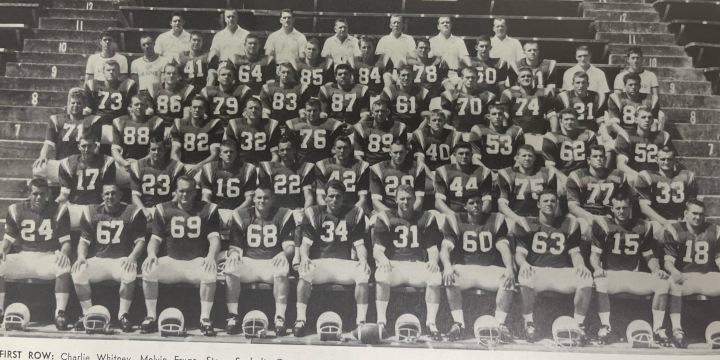
IMG_5302

Born and raised in Clinton, Louisiana, Billy Andrews knew from a young age that he wanted to play football. “When I was eight years old, our school hired a coach, Coach Russo, and he started a peewee football program. The minute I stepped on that field I fell in love with football. Maybe a bit too much.”

Billy was not particularly built to play football, but that didn’t dissuade him from his dream. “I was the skinny kid. Very slow, very small. I set my sights on playing in the NFL when I was probably nine years old.”

Billy would dedicate much of his young adult life to accomplishing this goal. At age 12, he began weight training. “My daddy drove me when I was 12 years old to Baton Rouge three times a week to train with Alvin Roy. He was one of the great athletic weight trainers in the NFL and the college ranks.”

He also credits this move as the impetus for his spiritual growth, which is today an important part of his life. “I see [Alvin Roy] being in Baton Rouge as providence of God to get me to the NFL, which ultimately is where I found the Lord.”

When it came time to decide on a school to attend for college, Billy’s high school coach from Silliman Institute, Coach H. L. Polk Jr., encouraged him to attend Southeastern. “Coach Polk was a Southeastern Hall of Famer,” Billy explained. “He helped the head coach Stanley Galloway recruit me.”

Billy attended Southeastern from 1963 through 1967. During his time in Hammond, he worked towards graduating with a bachelor of science degree focused on veterinary medicine, acquiring knowledge which he would later apply when working for his family’s dairy farm. But playing football at Southeastern is what prepared him for the first steps in his future and that legendary televised win in 1970.
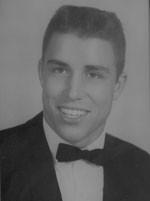
resize“Playing football at Southeastern prepared me very well to go to the NFL because of the quality of football there,” Billy said. “Coach Galloway had a great impact on me and he was tough on us, but that’s what we needed. I came to Southeastern weighing 162 pounds and grew from the training to 215. The entire coaching staff at that time helped me get to where I needed to be.”

His time at Southeastern and the relationships he built with his fellow players and students as a whole have stayed with him through his life. “I still talk to a good many of the people I played with back when I was at Southeastern. It was a close-knit group of players, and we all still stay in contact.”

Billy was first drafted into the NFL by the Cleveland Browns in 1967, the same year he graduated from Southeastern. The goal he had set for himself when he was only nine years old was now accomplished. He continued to play for the Browns for eight seasons, becoming their Defensive Player of the Year in 1971, the year after he had scored that game-winning touchdown. After his time with the Browns, Billy played for the San Diego Chargers for a season and then the Kansas City Chiefs for his last two seasons as a professional football player. Throughout his professional career, he played in almost 150 games.
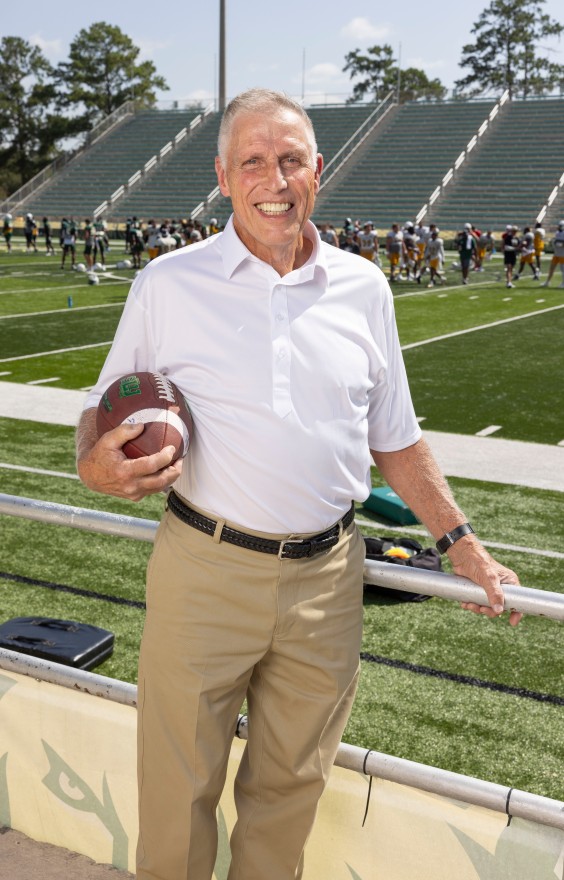
Billy Andrews

Even with all of those accomplishments, the thing that had the biggest impact on his life while playing in the NFL
was something else. “I worked hard and played myself into becoming a great player, and when I intercepted the ball in the Monday Night Football game it was like, this is it, but in my heart I was empty. I was an empty man though I had accomplished the high dream. But then I realized what God had done; he had worked in my heart.”

After he retired from playing football in the NFL, he returned to Clinton, Louisiana, to work his family’s dairy farm—an entirely new challenge for which he found himself unprepared but quickly adapted.

After everything he has done and accomplished, Billy’s love for Southeastern, football, and his God sticks with him. To this day, Billy still occasionally helps coach football at his old high school and continues to stay active with Southeastern Football.