Health Sciences Program

Providing New Educational and Career Opportunities Across the Healthcare Industry

A new program in Southeastern’s College of Nursing and Health Sciences is helping students achieve a strong, interdisciplinary foundation in healthcare, providing them flexibility to pursue fulfilling careers in a wide variety of
healthcare settings.

The Bachelor of Science in Health Sciences program, part of the Kinesiology and Health Studies Department, began in the Spring of 2020 to help students broaden their knowledge and obtain a cutting edge in the ever-changing and multifaceted healthcare field. This contributes to not only better career opportunities for students but also a stronger workforce that is able to tackle the unpredictable challenges of today and tomorrow.

Department Head of Kinesiology and Health Studies Dr. Charity Bryan explained how this is preparing Southeastern students for the next step in their education, offering “a flexible curriculum to complete requirements for admission into physical therapy, physician assistant, dental hygiene, public health, and athletic training programs.”

a071713_097

Southeastern has already seen an interest in the program from the community. Bryan said, “The new Health Sciences program has proven very popular with over 235 majors.” In response to the growth and interest, Southeastern has welcomed new faculty members to “expand our class offerings and provide additional research opportunities for students.”

The faculty members are knowledgeable about the program and excited to share their knowledge with future health professionals. Professor of Health Sciences Dr. Ralph Wood said, “This is the perfect degree for students who want to pursue careers in public health and healthcare-related fields, such as health coaching and patient navigation.”

The Health Sciences degree will have a direct benefit to our local and state community. According to a study published in 2018 by the United Health Foundation, Louisiana was ranked the unhealthiest state. The program aims to help alleviate this problem. “The Health Science degree will allow graduates to specifically address health problems and help individuals pursue better health outcomes, improve health literacy, and make healthier choices for themselves and their families,” said Bryan.

This program gives students the opportunity to pursue many career paths across the health field. It includes a solid foundation in public health courses including epidemiology and two-course sequences on chronic disease management; a course solely focused on motivational interviewing and health coaching; and the necessary training to plan, implement, manage, and evaluate evidence-based programs.

The flexibility throughout the program offers students the opportunity to choose 22 hours of health science electives. They can pick from courses in athletic training, biology, physics, chemistry, kinesiology, health systems management, psychology, nursing, microbiology, zoology, and family and consumer sciences. The electives provide students the option to complete coursework to gain prerequisites required for graduate school programs in athletic training, occupational therapy, physician assistant, physical therapy, or other allied health professions. Students can also complete the requirements to earn a certificate in digital health management or population health management. Program Coordinator Carrie M. Edwards said, “The 22 hours of elective provide a framework for students to not only complete prerequisites for graduate programs in the allied health
sciences but also the flexibility to choose courses of interest in health and wellness to create a more holistic health degree.”

Students can collaborate with nationally recognized faculty through research opportunities. Faculty members within the program have research experience in health coaching and counseling; drug, alcohol, and tobacco prevention; chronic illness in children; nutrition and physical activity; worksite health programming; health disparities; minority health; stress and health risk behaviors; and other research topics.

Students are encouraged to engage in learning opportunities beyond the classroom and interact with other students and health professionals through attending professional conferences. Some of the conferences include the National Health & Physical Literacy Summit, Society for Public Health Education (SOPHE), American School Health Association (ASHA), and American Public Health Association (APHA).

The career options post-graduation for students obtaining a Bachelor of Science in Health Sciences are bright. “Graduates will be prepared with a solid undergraduate foundation to pursue careers in public health, health
education, and health coaching, as well as graduate study and/or professional degrees in pre-health, such as occupational therapy, physical therapy, physician assistant, dental hygiene, public health, and athletic training,” said Edwards. Students completing this program will be equipped to take the Certified Health Education Specialist (CHES) examination to become CHES certified.

For more information on Southeastern’s Health Sciences program, email carrie.edwards@southeastern.edu or visit southeastern.edu.

By Mary Grace Kelley

Department of Sociology and Criminal Justice Presents Speaker Series “Voices of Justice and Change”

Southeastern’s Department of Sociology and Criminal Justice and the Social Justice Speaker Series are hosting the Criminal Justice Colloquium event “Voices of Justice and Change.”

Three speakers are scheduled for March 14, 23, and 29 on Southeastern’s campus in Fayard Hall, room 207. All events are free and open to the public.

Assistant Professor of Sociology and Criminal Justice William A. Chernoff said for the first time ever, changemakers transforming the face and soul of the justice system today will speak about their experiences with the justice system.

“By amplifying these voices, this speaker series aims to build lasting bridges between justice system professionals, service providers, scholars, advocates, and system-involved peoples and share the secrets to a more people-centered system of justice,” he said.

The first speaker in the series is Alex Johnson on March 14 from 3:30 to 4:45 p.m. Known as “PoeticSoul,” the Lafayette native encourages others to never give up, stand up, be fearless, and be heard, Chernoff said. She has worked as a teaching artist in Lafayette Parish Juvenile Detention Home and was a featured panelist during the 2016 Split this Rock Poetry Festival in Washington, DC, where she discussed Language of the Unheard: Rural Children of Color. Johnson recently published a book of poetry titled Poisonous Thoughts and lead the Eyes of the Sun mural in Lafayette, a project sponsored by 24 Hour Citizen Project.

For more information, click here.

Giving Back: Freda Oddo Green and Ruth Settoon Kenelly

Two beloved members of the Southeastern community have left a lasting legacy on students, the University, and those who knew them, embodying the spirit of giving back and of true Lion Pride.

Some people become members of our Southeastern Family by earning their degree here, some by joining the ranks of staff and faculty. Others are initially drawn to becoming part of the community on their own through a variety of reasons—an appreciation for or interest in helping boost the economic and cultural impact the University has on the region, the fun and welcoming atmosphere, a desire to help current students successfully achieve all of their goals, and even love.

This past year Southeastern lost two very special members of its community: Freda Oddo Green and Ruth Settoon Kenelly. Each became a deeply rooted member of the Lion Pride through a beautiful, social personality; a desire to give back; and love for a fellow Lion. And each left an indelible mark on the institution and on those who knew them.

FREDA ODDO GREEN

fredacr

Freda was a force of nature. Born January 19, 1923, as an only child, she was a woman before her time—independent, strong, hard-working, determined, and not afraid to speak her mind, but also always displaying an impeccable sense of fashion and etiquette.

Freda had a passion for teaching younger generations the importance of etiquette, for traveling, and for spending time with family and friends. Wherever she went, she would form lasting friendships with the people she met, and she traveled the world.

Freda Green with grandaughter Cheryl BrunoAfter living in New York and New Orleans, Freda moved to Hammond from Amite for the great-granddaughter she raised, Michelle, who was attending Trafton Academy. Freda was first introduced to campus through Michelle, whose school used the facilities at Southeastern for running track. As Freda increasingly became involved in the local community with organizations like the Greater Hammond Chamber of Commerce and her church, she began meeting proud Lions. Recognizing Freda’s talent for getting things done, they invited her to join their activities at the University. When it was time for Michelle to enter college, she chose to attend Southeastern, strengthening Freda’s ties to and love for the University.

freda-green-new-orleans-la-obituaryFreda had a strong philanthropic spirit, and she never hesitated to lend her time and talents to organizations across the region. At Southeastern, she served as a member of the Community Advisory Council, a charter and past board member of F.E.Lions (Female Enthusiasts for Southeastern Athletics), a past mentor of the Women’s Basketball team, and a member of the Columbia Theatre Advisory Board.
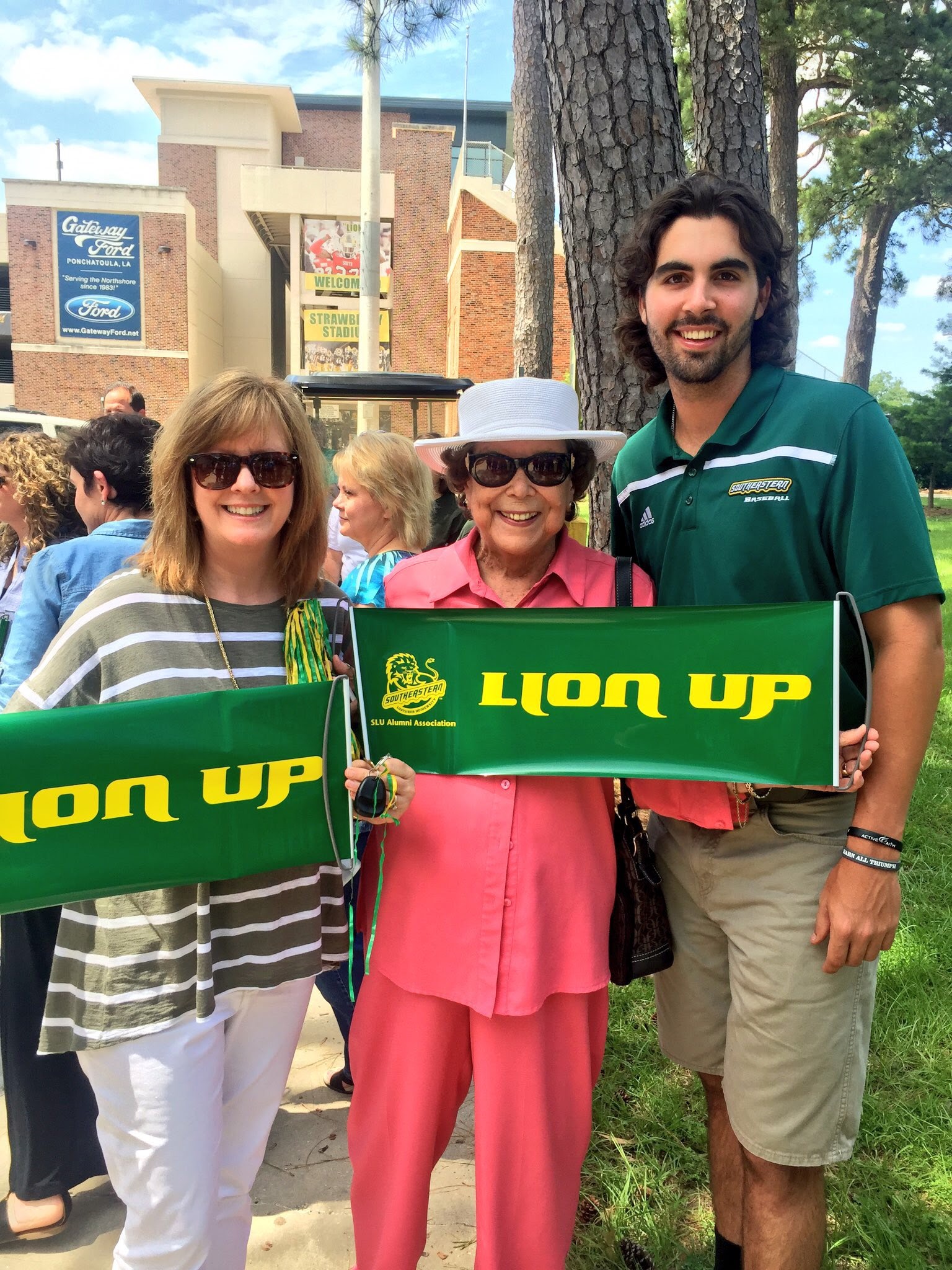
RUTH SETTOON KENELLY

IMG-1354Ruth was born in Denham Springs, Louisiana, on July 13, 1929, to Carl Chambers and Lela Barnett Chambers, the latter of whom started the family’s Lion legacy by becoming a 1934 graduate of Southeastern. After graduating from Denham Springs High School, Ruth attended Baton Rouge Business College. In 1947, she married V.E. “Son” Settoon. The pair owned and operated a general goods store together in Springfield, Louisiana, for close to 40 years, until Son’s passing.
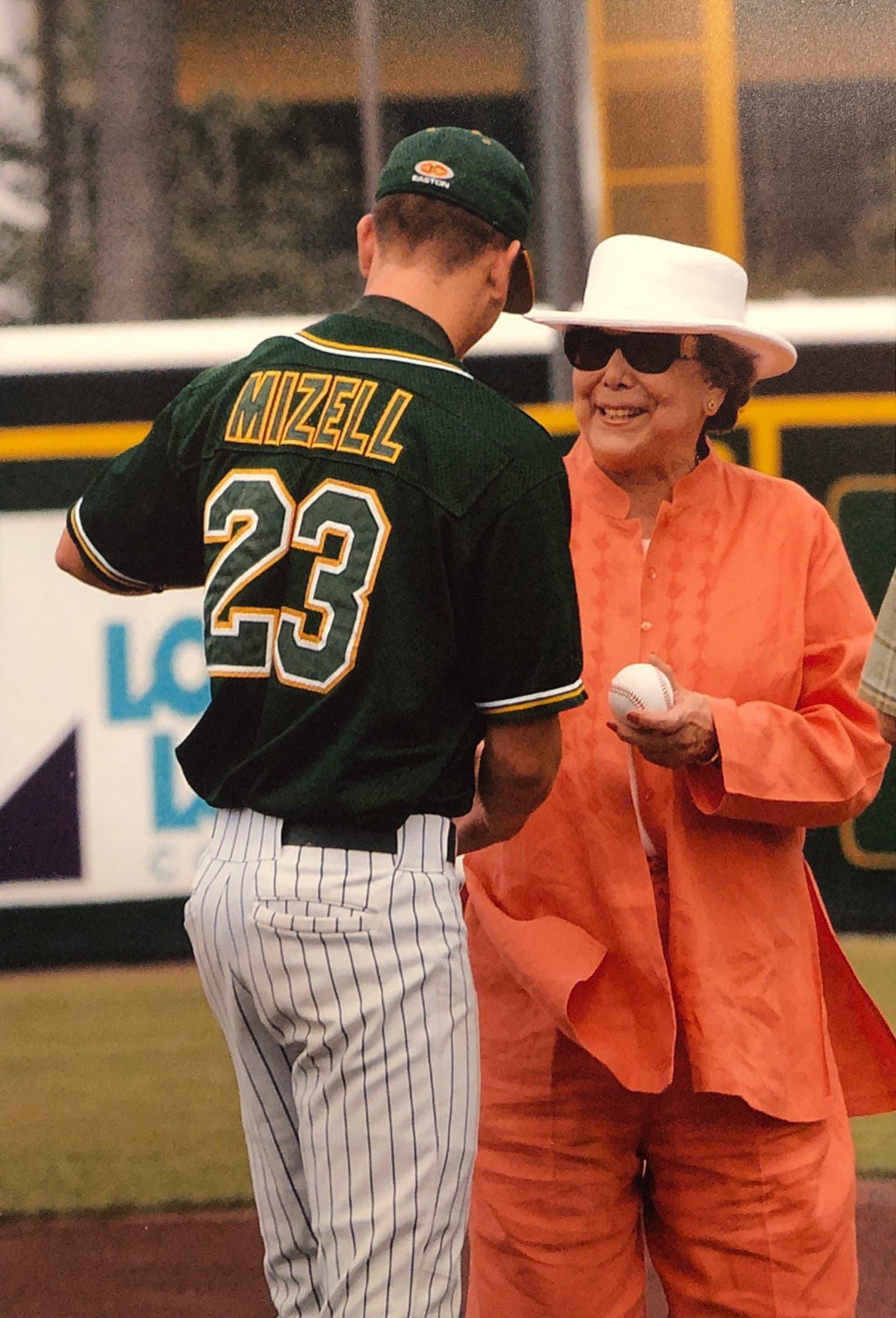
In April of 1990, Ruth married legendary Southeastern director of athletics and Hall of Fame coach Pat Kenelly, attending almost all Southeastern home football and baseball games from then on. She also became a warm friend, generous supporter, and advocate of Southeastern, getting to see her two daughters, three granddaughters, and a grandson-in-law earn their degrees from the University.

“Whether she was called ‘Mama Ruth’ or the ‘Queen of Hammond,’ to know her was to love her,” said Mary Hannah (Prevot) Johnson, her granddaughter and the prior assistant athletics director for athletic advancement at Southeastern.
82C40370-30ED-40FD-B506-01B73C1B9121cr
As a loyal supporter of Southeastern over the years, Ruth made a profound impact on countless students and the University through the establishment of the Pat Kenelly Endowed Scholarship in Baseball in 2004 and the naming of the Coach Pat Kenelly Baseball Diamond in 2006, along with additional annual program support. And, her memory keeps on giving through the newly initiated Ruth Settoon Kenelly Memorial Scholarship in Baseball, currently being funded by her devoted family and friends.

“Ms. Ruth was loved by her Southeastern Family,” added Wendy Lauderdale, vice president of University Advancement. “She had a way of making everyone feel special. And, she had an amazing ability of always reaching out and showing love and support at just the right time. It was like she was emotionally connected to all of us.

Scan Feb 27, 2021“Ms. Ruth could usually be found having breakfast with one of the members of the Southeastern Family at Yellow Bird, a local establishment in Hammond. She invited President Crain every time, hoping to have yet another opportunity to let ‘John’ know just how special she thought he was. Ms. Ruth loved everything about Southeastern and Southeastern loved everything about Ms. Ruth. We have all been blessed to have known her and rest assured that her memory will live on for generations to come in the hearts of her Southeastern Family.”

By Sheri Gibson

Cyber Security Summit for Educators

Southeastern will host a free professional development workshop for educators on Saturday, March 12, from 9 a.m. to 3 p.m. for seventh through 12th-grade teachers. Scheduled in the Innovation Hub in Sims Memorial Library, the summit will cover basic cybersecurity concepts and give an overview of the summer GenCyber Professional Development Program.

The National Security Agency and the National Science Foundation have provided funding for this CyberSecurity Summit and the GenCyber Professional Development Program, also for educators, to be held in July. Southeastern was one of 32 universities and colleges nationally to be selected as a camp host last year and is the only university in Louisiana to offer it this year.

Computer Science faculty member Bonnie Achee will serve as program director for the GenCyber program with Southeastern faculty teaching camp courses. The event is free, and both in-person and virtual attendance options are available.

For more information or to register, visit southeastern.edu/lionscode.

The Sound of Success

A Southeastern professor and two student researchers teamed up to develop beyond gold standard cochlear implant sound technology in only eight weeks, earning a national award.

Southeastern Professor of Physics Sanichiro Yoshida and graduate students Anthony Calmes and Conor McGibboney, both of Hammond, are making waves in research that could one day help others. Their efforts were recently recognized on a national level, earning an honorable mention in the first Cochlear Implant (CI) Hackathon. The team, with no prior experience in cochlear or sound technology, achieved better than the “gold standard,” a reference implementation of a fully featured cochlear implant sound coding strategy.

The CI Hackathon used a crowdsourced ranking structure to judge entries against each other and against a baseline, which essentially gives an approximation of what a cochlear implant sounds like today.

“Southeastern’s entry performed better than the baseline in the category of simple words. Essentially this means that their improved algorithm outperformed what the cochlear implant can do today in that sound category,” explained CI Hackathon Project Leader Leah Muller. “This is a huge feat in itself. We as organizers were both surprised and excited when we started seeing teams perform better than baseline, because that meant we were succeeding in the second part of our mission with the Hackathon: to generate promising new strategies that may improve hearing for real cochlear implant users.”

080321_005
Southeastern Professor of Physics Sanichiro Yoshida (left) teamed up with graduate students Conor McGibboney (center) and Anthony Calmes (right) to create national award-winning cochlear implant sound technology.

Cochlear implants are electronic devices that restore hearing to people who are born without hearing or who lose their hearing over time. The implants allow some deaf people to hear sounds by overriding the innate hearing mechanisms of the ear. Although cochlear implants can restore or improve hearing, some users may experience difficulty, especially with hearing speech in a noisy environment and enjoying music.

Held virtually, the CI Hackathon encouraged national participation with contestants from five continents. Top tier entries represented academic institutions, commercial entities, and individuals. The Southeastern team placed in the top four against sixty registered teams from universities all over the world, as well as private biotech firms and other tech companies.

The competition was a joint effort between Advanced Bionics, University of California San Francisco, and University of Minnesota with a goal to inspire members of the public to improve CI sound processing. The hackathon ranked entries based on their performance in four sound categories—a series of three unrelated one-syllable words, natural speech, speech in a noisy background, and music across a wide range of styles. Advanced Bionics, one of three FDA-approved CI manufacturers, sponsored the contest and provided the gold standard reference.

Advanced Bionics and the University of Minnesota further provided a software framework for contestants to develop and test their own algorithms, including an acoustic simulation of the sound percept produced by a CI in
order for normal-hearing listeners to be able to optimize and ultimately judge the sound quality of the CI sound
processing algorithms.

Cochlear_Implant

Yoshida, whose expertise is in optical interferometry and field theory, heard about the competition and was intrigued by it. The opportunities it presented to bring together many different discipline backgrounds and fields for a common purpose was particularly enticing. Yoshida connected with Calmes and McGibboney, who were current graduate students in his department, and formed a team to dig deeper into this project. Dean of the College of Science and Technology Dan McCarthy encouraged him to enter the competition.

McGibboney said that what inspired him to compete at the CI Hackathon is general curiosity about the human brain. “Humankind has progressed so far, yet a lot of the mystery about what life is and how humans will continue to evolve is locked inside the human brain,” he said. “It was an excellent opportunity to take some of the knowledge we learned in physics and other areas and see what we could uncover or how we could apply it to the human brain.”

Yoshida, Calmes, and McGibboney worked on the project over winter break. Yoshida explained that the software his team developed for the competition included basic strategies, such as increasing the gain of part of the control unit. Next, Calmes and McGibboney tested the software and reported to Yoshida with the results. He then modified the strategy and sent it back to the students.

“The goal of the software development was to improve the performance of the sensor, the part that receives the sound and converts it to electronic signals; of the controller and conditioner, the part that controls various parameters to condition the electric signals; and the actuator, the part that generates the output sound from the electric signal processed by the controller and conditioner unit,” Yoshida explained.

“The sensing/actuation algorithm is similar to that used by LIGO (Laser Interferometer for Gravitational-wave Observatory),” he continued. “I participated in the LIGO project for about 10 years. This experience helped me develop the software for the Cochlear Hackathon, since our software development was physics based.”

While Yoshida and his team were able to draw upon extensive knowledge from such other areas, they actually saw the lack of experience with CI as an advantage in that it helped them form a unique approach to the competition.

“The scientific content of the competition was similar to what I covered in a graduate physics course in the semester prior to the competition,” Yoshida said. “What set our entry apart from the others was that our software design is based on physics, whereas our competitors developed their versions based on computer science or medical science.”

While an advantage may have been achieved in this way, the team’s accomplishment without prior experience in CI and sound technology is highly significant.

“Southeastern was one of the few teams that entered the hackathon with no background in acoustics, hearing, or cochlear implants at all,” explained Muller. “Over the course of eight weeks from Hackathon opening to final
entry, they not only learned the necessary principles of cochlear implant technology and sound processing, but they also used that knowledge to come up with a top-ranked processing algorithm.”

“The fact that Dr. Yoshida and his team beat out major research universities when he and his students had never worked on cochlear implants or anything like them before is simply astounding,” McCarthy said.

a080321_169

Along with the feat achieved in CI research from Yoshida and his students working together, participating in this project also had a profound direct impact on and served as a great hands-on learning opportunity for the younger researchers.

“The programming was definitely the most interesting thing I learned while undertaking this project with the CI Hackathon,” Calmes said. “I had not really done much with the computer programming aspect of it before, but it definitely was the most intense area for me.”

For McGibboney, realizing the direct impact that science can have on people’s lives created the biggest spark in him. “Sometimes, especially during a pandemic, you can develop distances between people, and I am aware that being deaf can cause a disconnect,” he said. “However, the idea that we could share in the first experience of listening to music again—and when I first learned how that impacted people that were wearing the cochlear implants—that was the most amazing thing to me. That’s a real connection from science in the classroom to making it into the marketplace to improve people’s lives.”

By Tonya Lowentritt

Lion Pride Career Closet

A new Southeastern initiative is outfitting students for career success.

Closet

For many college students in the U.S., financial worries are an everyday burden. And once all the costs associated with earning a degree are paid, both monetary and in terms of hard work and time, there can still be one more barrier to landing that first big job—the need for professional clothing.

According to a 2016 report from CareerBuilder, over a quarter of surveyed job seekers spent more than $200 on interview attire and other related expenses. While this might not feel like a significant hit to someone who is already in a financially stable position and able to invest in finding the next step in their career, it can hold back a student or recent graduate trying to progress on their path.

Upon identifying this problem, Southeastern—which has also been ranked as the number one university in Louisiana for least student loan debt, thanks in part to the Southeastern Promise, textbook rental program, and advanced scholarship opportunities—developed the Lion Pride Career Closet to meet this need. The Southeastern Wesley Foundation, Southeastern Foundation, and the Office of Career Services partnered together to provide professional outfits to members of the campus community.

Closet

“It’s something we all feel very strongly about—helping students be as successful as possible in every way,” said Melissa Guerra, associate director of the Southeastern Wesley Foundation. “We all know that professional clothing is expensive, but it’s especially so for college students who are barely making ends meet with part-time jobs. We wanted to be able to provide this service to help the Lion Nation look and feel confident going into a job interview, career fair, or even giving a class presentation after all the hard work they’ve been putting into getting their degree.”

The Lion Pride Career Closet was soft-launched in May 2021. It is designed as a boutique-style shopping experience and is currently located in room 2017 of McGehee Hall. Students are able to make an appointment via sluwesley.org to assemble their new work-ready wardrobe at the Career Closet. The initiative is being managed by Wesley, a United Methodist-sponsored campus ministry open to all students and housed across the street from Southeastern’s campus. Wesley Foundations are located at countless universities across North America and the United Kingdom. Along with the Career Closet, Southeastern’s Wesley Foundation also oversees the Southeastern Food Pantry; provides free lunch every Wednesday; operates a non-profit coffee shop, Kairos Koffeehouse; houses up to 12 students at a time; and provides student work and social opportunities.

Closet

“We always say we exist to serve the students, faculty, and staff of Southeastern body, mind, and soul, and this is such an amazing and much-needed way for us to do that,” said Guerra.

Wesley collects items for the Career Closet and then organizes and stores them at the Wesley Center until they are able to be displayed in the Career Closet. Donations of gently used professional clothing, shoes, and accessories for both men and women are requested to help serve as many students as possible. Drop-off sites are available on campus at the Southeastern Alumni Center and the Wesley Center, as well as across the region at Amite City Chamber of Commerce, Livingston Parish Literacy Center, Tangipahoa Chamber of Commerce, Ponchatoula Chamber of Commerce, FUMC Covington, St Tammany Chamber of Commerce in Covington, and the St Tammany Chamber of Commerce in Slidell.

“Students should know someone cares about them and their success, not just their academic success but their all-around success in life,” said Guerra. “After four or more years of hard work, clothing should not stop you from reaching that next step in your life.”

By Sheri Gibson

Launching New Master’s Degree in Athletic Training

Southeastern’s Department of Kinesiology and Health Studies is now offering a master of science degree in athletic training. Department Head Charity Bryan said the degree will provide a comprehensive, progressive, educational and clinical foundation to prepare graduates for a career in athletic training, which is recognized by the American Medical Association as a healthcare profession.

“Certified Athletic Trainers are healthcare professionals who collaborate with physicians to optimize activity and participation of patients and clients in professional and collegiate sports, public and private schools, sports medicine clinics, occupational health settings, and physician offices, as well as many other emerging and developing settings,” she said. “Athletic training encompasses the prevention, diagnosis, and intervention of emergency, acute and chronic medical conditions involving impairment, functional limitations, and disabilities.”

Classes in the program are taught by nationally recognized experts in their fields who hold doctoral degrees, she explained. Program students can gain clinical experience with high school, college, and professional teams, as well as various other settings, and will be eligible to sit for the Board of Certification national credentialing examination. Upon completion of the program, students will have graduated from a nationally accredited athletic training program.

MSAT Program Director Ryan Green said jobs associated with the degree include athletic trainer, orthopedic specialist, sports medicine assistant, physician’s assistant, physical therapist, exercise physiologist, health coach, strength and conditioning specialist, and teacher.

For more information, contact the department at MSAT@southeastern.edu or 985-549-2129.

Students Dominate Society of Professional Journalists Awards

Students at the Southeastern Channel won nine Mark of Excellence Awards, including five first-place honors, at the Society of Professional Journalists’ annual Region 12 conference.

Southeastern students received the most television and broadcast videography honors out of all universities in the competition, including the most first-place awards with five and second-place finalist awards with four. The closest competing university had two first-place awards. Universities competing included Louisiana State University, the University of Arkansas, University of Mississippi, Mississippi State University, Harding University, and Middle Tennessee State.

The Mark of Excellence Awards honor the best of collegiate journalism from a calendar year. The SPJ Region 12 comprises all universities in Louisiana, Mississippi, Arkansas, and Tennessee.

Mark of Excellence Awards were judged by SPJ industry professionals who were directed to choose entries they felt were the best in student journalism. If no entry rose to the level of excellence, no award was given.

“The Society of Professional Journalists has long been one of the most respected journalism organizations. For our students to dominate the competition against much larger universities is truly an outstanding achievement and, once again, shows that our students and program are the best in the region,” said Southeastern Channel General Manager Rick Settoon. “These awards reflect the high quality of broadcast journalism in both news and sports production by our students, and I’m very proud of their high standards and strong efforts. I’m extremely happy that their hard work has been rightly recognized.”

First-place winners included the Southeastern Channel’s student newscast Northshore News for “Best All-Around Television Newscast;” the channel’s Southeastern Times for “Best All-Around Television News Magazine;” Dylan Domangue of Houma for “Broadcast News Videography;” Jacqueline Doucet of Covington for “Broadcast Feature Videography;” and Caroline Fussell of Covington for “Television Sports Reporting.”

Receiving finalist or second-place recognition were Chris Rosato of Mandeville for “Television News General Reporting;” John Sartori of Mandeville for “Television Sports Reporting;” and Doucet for both “Television Feature Reporting” and “Broadcast Feature Videography.”

The Nov. 11, 2020 episode of Northshore News won first place for “Best All-Around Television Newscast,” the sixth time the channel’s newscast has won first-place honors in the region. Anchors for the newscast included Rosato and Lily Gayle of Greensburg with reporters Rosato, Gayle, Fussell, Kaylee Normand of Mandeville, Raychelle Riley of Denham Springs, Coby Sanchez of Baton Rouge, and Kayla Martin of New Orleans.

The newscast featured Sanchez, a certified storm spotter for the National Weather Service, capturing dramatic live footage of Hurricane Zeta from inside the storm’s eyewall.

The Dec. 7, 2020 episode of the channel’s Southeastern Times was named first-place winner for “Best All-Around Television News Magazine.” The program featured anchors Carson Fryou of Ponchatoula and Fussell, along with stories by reporters Fussell, Fryou, and Doucet. It marked the second consecutive year that Southeastern Times brought home first place.

Southeastern Times includes feature stories that spotlight faculty, students, and Southeastern campus programs, along with people and events in the southeast Louisiana region. The winning program and feature stories were produced in Settoon’s Communication 409: Production of the Television Newsmagazine course.

Doucet’s three individual awards included the story, “A Quarantine with Stars,” which won first place in the “Broadcast Feature Videography” category and second place in the “Television Feature Story Reporting” category. The story centers on Father Mike O’Rourke, a Catholic Dominican priest serving as chaplain for college students at the St. Albert’s Catholic Student Center on campus.

O’Rourke’s love of astronomy led him to spend a two-week quarantine during the pandemic in the Copper Bricks State Park in Quanha, Tex., where he stargazed using his telescope with a clear view of open sky.

Doucet also won finalist recognition in “Broadcast Feature Videography” for “Our Daily Bread,” a story about a Hammond food pantry and its food distribution during the pandemic.

Domangue won first place in “Broadcast News Videography” for his Northshore News story “Pearl River Flooding.” It marked the third straight year that Domangue won first place for his videography. In 2019 and 2020 he finished first and second in the nation for both news and sports videography.

Fussell won first place for her feature story “Lessons, Leaders, and a Salter Legacy” about legendary Covington High School football coach Jack Salter.

Rosato won finalist honors for his Northshore News story “Mail-In Voting” about the 2020 presidential election while Sartori was a finalist for “The Last Time the Lady Lions Made the Playoffs,” a story about Southeastern’s women’s basketball team for the student sportscast, The Big Game.

Rosato is now a TV news reporter at WAFB-TV Ch. 9 (CBS) in Baton Rouge, while Riley is a news reporter for WGMB/WVLA-TV (FOX 44/NBC 33) in Baton Rouge. Domangue is sports director/anchor for KALB-TV Ch. 6 (NBC) in Alexandria, La., while Sartori is a sports anchor/reporter at KTAL-TV Ch. 6 (NBC) in Shreveport.

In its 19 years of existence, the Southeastern Channel has won over 400 national, international and regional awards, including 22 awards from the Emmys. The Southeastern Channel can be seen on Spectrum Cable 199 in Tangipahoa, Livingston, St. Tammany and St. Helena parishes and on mounthermonTV.com for viewers in Washington Parish. In addition, the live 24-7 broadcast can be seen on Roku, Apple TV and the channel’s website at thesoutheasternchannel.com, which also offers programs via video on demand. The Southeastern Channel is available on Facebook, Twitter, Instagram and YouTube.

Southeastern Opera Workshop Presents “Cendrillon”

Southeastern’s Opera Workshop will present Cendrillon (Cinderella) by French composer Pauline Viardot Feb. 16–19. Scheduled in Pottle Auditorium at 7:30 p.m. each evening, the production is free.

“Opera Workshop first presented this delightful retelling of the familiar Cinderella fairy tale in the spring of 2013, and there are a few twists in this version: the stepmother is replaced by a stepfather with a shady past, and Prince Charming and his First Chamberlain switch places to deceive Cendrillon and the other guests at the ball,” said Opera/Music Theatre Workshop Director Chuck Effler. “But there’s still the part about trying on the slipper!”

For a quarter of a century, starting around 1850, Viardot was one of the most famous opera singers in Europe and Russia, and one of the most influential European musicians until her death in 1910, Effler explained.
 
“After retiring from singing, she began teaching, and composed over 200 art songs as teaching pieces for her students. Many of those songs were published and are still sung today,” he said. “She also wrote five salon operas, short operas with piano accompaniment meant to be presented at musical soirées in the homes of fashionable Parisians. Cendrillon is the last and the only one to be published.”

The production will be sung in an English translation by long-time guest stage director Rachel Harris, who directed the 2013 production and returns to direct the current production.

For more information, contact the Department of Music and Performing Arts at 985.549.2184.

New Industry Scholarship Helps Support Students

Southeastern’s Department of Industrial and Engineering Technology has received a $25,000 contribution from Turner Industries to establish The Turner Industries Endowed Scholarship to benefit students in disciplines offered by the department. Beginning in 2022, a $1,000 scholarship will be available to a student selected by the faculty annually.

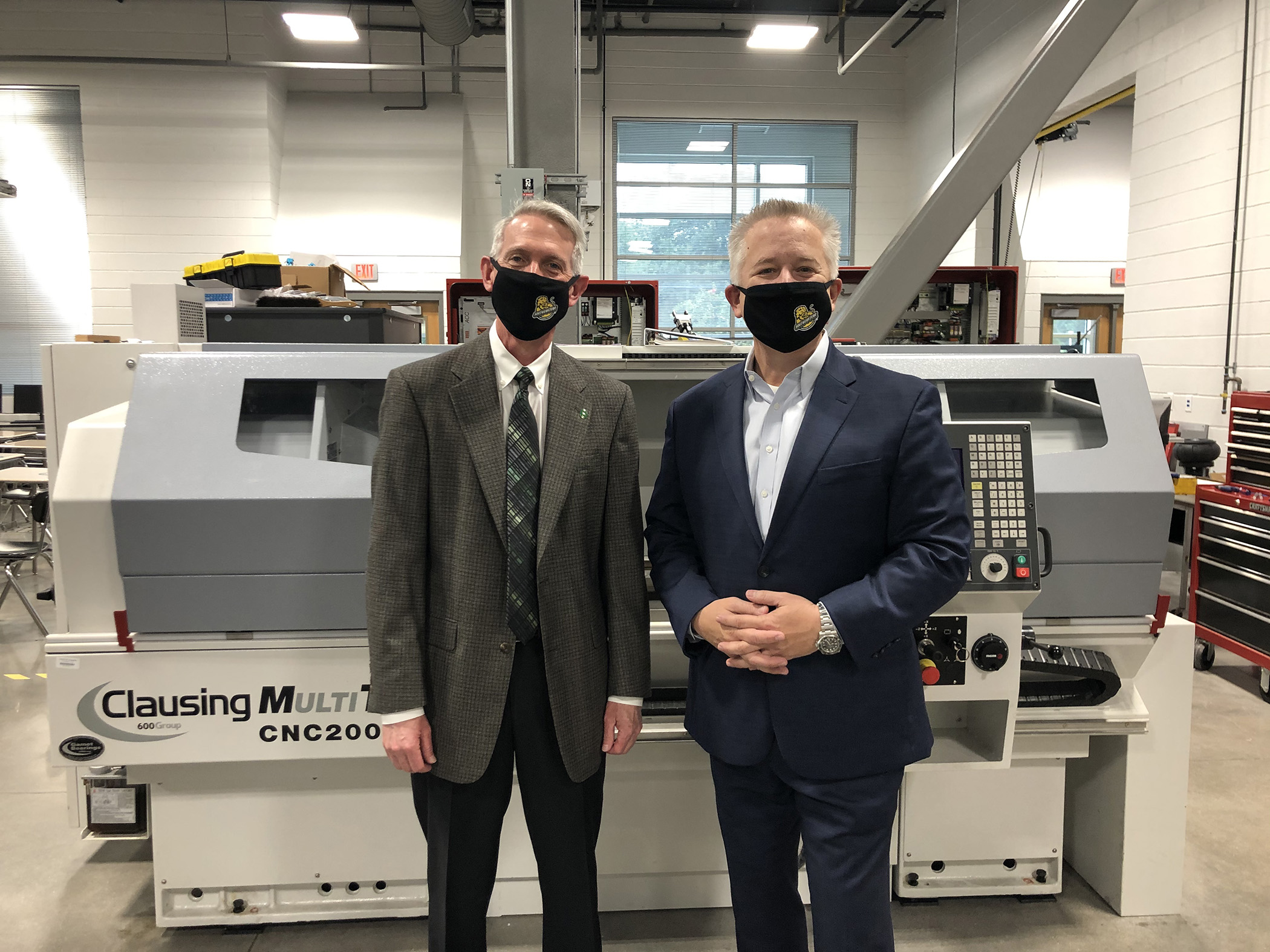
Recently, President and CEO of Turner Industries Stephen Toups visited Southeastern’s Science and Technology Building to meet faculty and students and learn firsthand the offerings available to students in the department. Pictured from left are Southeastern President John L. Crain and Toups.

slu_turner_industries

Headquartered in Baton Rouge, Turner Industries provides turnkey services and solutions to the companies that produce fuel, energy, and products essential to modern life. With four main division lines – Construction, Maintenance and Turnarounds, Fabrication, and Equipment and Specialty Services – Turner Industries employees work across the United States for clients around the world.