Southeastern has experienced growth in two key areas – enrollment and retention of students – this academic year.
The university realized solid increases in enrollment across both undergraduate and graduate students. Undergraduate enrollment rose by 2.1 percent, while graduate enrollment experienced an increase of 13.3 percent.
“Reaching my 100th day in office bears with it the great news of our fall 2023 enrollment report. Southeastern has been working on a concerted and university-wide effort to strengthen purposeful enrollment,” said Southeastern President William Wainwright. “Seeing growth in so many student categories indicates that we are certainly moving in the right direction and have a post-pandemic path forward. I know this is only the beginning.”
With an overall enrollment of 13,888, an increase of 2.9 percent, Southeastern experienced growth in several categories. New or incoming student increases included transfer students, graduate students, dual enrollment students, and reentry students. Southeastern experienced its largest-ever dual enrollment of high school students, and the Honors Program had a significant increase of 16.2 percent, resulting in the largest enrollment in the program’s history. Also, the university saw a 30.9 percent increase in international students.
“While growing our new student base is important, having gains in retention demonstrates our commitment to student success. Ensuring every student has the greatest possibility to graduate is one of our paramount goals,” added Wainwright.
In addition to enrollment growth, Southeastern also reported successful increases in retention of students. The freshman retention rate, for example, was the highest ever at 76 percent. A significant increase in retention of African American students was realized, as well as increases in retention of male and dual enrollment students.
Southeastern currently offers over 150 programs of study, including many that are regionally and nationally ranked.
Southeastern Laboratory School recently announced that it has earned accreditation by Cognia™, a non-profit organization that provides quality assurance for schools, school districts, and education service providers.
Formerly AdvancED, Cognia nationally recognizes districts that meet rigorous standards focused on productive learning environments, equitable resource allocation that meets the needs of learners, and effective leadership. Earning accreditation from the Cognia Global Accreditation Commission means that the school is accredited and that Southeastern Laboratory School is recognized across the nation as a school that meets Cognia standards of quality, maintaining a commitment to continuous improvement.
“School accreditation as conferred by the Cognia Global Accreditation Commission provides the Southeastern Lab School a nationally recognized mark of quality for the school,” said Dean of the College of Education Paula Calderon. “It demonstrates to our community our commitment to excellence, our openness to external review and feedback, and our desire to be the best we can be on behalf of the students we serve.”
“Our staff has committed itself to not only student growth but also professional growth,” said Southeastern Lab School Principal Stephen Labbe. “Our Cognia accreditation shows the hard work of our teachers, our students, and our school community. Also, the feedback we received from the review will help us to continue to grow in all areas of our school.”
To earn Cognia accreditation, a school district also must implement a continuous process of improvement, and submit to internal and external review. Schools in good standing can maintain their accreditation for a five-year term.
“Cognia Accreditation is a rigorous process that focuses the entire school and its community on the primary goal of preparing lifelong learners in engaging environments where all students can flourish,” said President and CEO of Cognia Mark A. Elgart. “Southeastern Laboratory School is to be commended for demonstrating that it has met high standards and is making progress on key indicators that impact student learning.”
Cognia is the parent organization of the North Central Association Commission on Accreditation and School Improvement, Northwest Accreditation Commission, and the Southern Association of Colleges and Schools Council on Accreditation and School Improvement. Parents and interested community members can learn more about Cognia Accreditation at cognia.org.
Hundreds of members of the Southeastern community have chosen to make life-saving gifts by donating bone marrow to unknown patients. Here is just one of their stories.
BY SHERI GIBSON
During Homecoming Week 2013, Southeastern student Alika Jones made a choice that would eventually save a life—and inspire countless others to do the same. At a tent set up near Friendship Circle for recruiting potential bone marrow donors, she participated in a quick mouth swab to register for the donor database, setting herself on a life-altering path.
Southeastern’s campaign to help increase the donor database and matches started the year before, when beloved alumna Robin Roberts announced she would be receiving a bone marrow transplant to combat bone marrow myelodysplastic syndrome (MDS). Her sister Sally-Ann Roberts, long-time WWL-TV anchor, was able to provide the needed bone marrow for her, but for many others finding a match isn’t so easy. In fact, around 70 percent of patients have to rely on anonymous donors.
When Southeastern administration heard what Robin would be going through, they jumped into action to show their support for her all along the way. A campaign called Swabbin’ for Robin was launched in partnership with Be the Match, a national bone marrow donor registry and program, with events spanning over the course of the next year. Students turned out in droves in honor of Robin and to help others who they had never met.
Robin Roberts arrives in Hammond in 2013 for Southeastern’s Swabbin’ for Robbin event.
“We did this because Robin had to have bone marrow and to support her,” said Vice President for University Advancement Wendy Lauderdale. “But there were so many students that came forward, like the story here today [of Alika Jones].”
In total, 140 people from the 2012-2013 drive were matched with patients, helping them live long into the future.
Alika was in this number. It can often take years for a match to be made, and about five years later she received a call. There was a teenage boy, Josiah Knight, who needed her help.
Although facing some health obstacles of her own, Alika was determined to do what she could for this family she had never even met. “Being a mother made me want to do it even more,” she said.
Bone marrow donor Alika Jones meets her recipient, Josiah Knight.
Another five years later she had the opportunity to talk to Josiah and his mom, Keesha Wilson, for the first time. “Just speaking with his mother, hearing everything she went through, made me feel so good to know I was able to help them,” Alika said. “It was overwhelming.”
“I’m very appreciative of how Southeastern worked with Be the Match to set up the drive, and of the love they still have for Robin and others,” she added.
In February 2023, in honor of 10 years since Robin’s own bone marrow transplant, another drive was held on campus in partnership with Be the Match and Good Morning America (GMA). And with it came a special surprise for Alika.
On the court of the University Center, where Robin once played, Alika was seated for an interview with the GMA crew about her own experience donating. Then at the end, some special guests walked in: now 20-year-old Josiah and his family. They had flown in from California just to finally share their gratitude with Alika in person.
GMA interviews Alika Jones at the University Center.
“I’ll appreciate her for the rest of my life. Have a bond with her for the rest of my life,” said Keesha, after the emotional, heartfelt meeting. “Josiah is so happy now.”
Their story was later broadcast across the country, inspiring others to participate as well. And that same day on Southeastern’s campus, students and other members of the University community once again turned out to give back—with over 230 new registrants added to the Be the Match database.
“Be aware, find out, because you could save a life too,” said Keesha. “And you don’t even know whose life you could be saving.”
Since 2002, the Southeastern Channel has been producing original, award-winning content for local audiences, while setting its students on a path to career success.
BY RICK SETTOON
A flip of the switch was all it took, and the Southeastern Channel was formally “on the air,” christened by a small group of officials from Southeastern and Charter Cable as the University’s new educational access television station. Little did any of the group realize at that moment on July 9, 2002, in University Center Room 130, that they were launching what would become one of the premier college television stations in the country.
Then Southeastern President Randy Moffett (front row, second from left) officially opens the Southeastern Channel at a ribbon cutting with then channel General Manager Rick Settoon (front row, third from right), faculty, staff, and partners.
Since that time, the channel has already won over 500 national, international, and regional awards, including 23 Emmy awards and first place in the nation 12 times. It has produced over 200 graduates working in the television, video, film, and marketing industries.
In the beginning, the Southeastern Channel was established as an educational cable channel by then-Southeastern President Randy Moffett, who saw the station as an innovative educational outreach venture that would allow the University to reach into the homes of students and residents.
The channel’s programming would help realize the University’s mission of furthering the educational, cultural, community and business development of southeast Louisiana, while also providing great promotion of the University, its faculty, and its programs. The Southeastern Channel would also serve as fertile training ground for students focused on careers in broadcasting, television, video production, and marketing.
In creating the channel, Southeastern partnered with executives at Charter Communications, who loved the idea that its local educational channel would produce and air original telecourses, or academic courses that could be watched and taken for course credit by students who couldn’t make it to the University’s campus. Over the next 21 years, this would result in Southeastern television courses spotlighting faculty in a wide variety of fields.
Initially, the Southeastern Channel reached into Tangipahoa Parish and half of Livingston Parish on Charter for a potential viewing audience of 57,000 viewers. Within a year Southeastern’s station had expanded to cover St. Tammany and Washington parishes as well, essentially all of the Northshore, for a potential Charter viewing audience of 240,000.
In addition to Charter (now Spectrum) cable channel 199, today the channel can be watched anywhere on the popular streaming services Roku, Apple TV, Amazon Fire TV, and the Spectrum App. The live 24-7 webcast can be viewed at thesoutheasternchannel.com and mounthermonTV.com.
At the outset, almost all of the channel’s programming, roughly 98 percent, had to be acquired or licensed from educational providers like Annenberg, the Research Channel, NASA-TV, Classic Arts Showcase, and Louisiana Public Broadcasting. However, to meet the demand for original, local programming, which was also the channel’s initial plan, within two years 95 percent was originally produced and focused on people and topics within the viewing area.
Over the next few years, that push resulted in over 40 original TV series covering the channel’s programming mission of educational, community, entertainment, and sports. The channel began producing newscasts; newsmagazines; sportscasts; coach’s talk shows; game broadcasts; documentaries; faculty lectures and forums; public affairs roundtables; and shows about Northshore business, history, tourism, nature, schools, and health organizations.
Additionally, the Southeastern Channel produced and aired Northshore and statewide political debates and forums, including the Louisiana Gubernatorial forums in 2003 and 2015. In the latter, the channel partnered with LPB for a live statewide forum moderated by a Southeastern Channel news anchor, Paul Rivera, with University students as panelists.
On the entertainment end, the 24-7 lineup was dotted with student comedy, film, and music video shows, along with a series spotlighting Northshore artists. The channel shot and aired Southeastern live events like music concerts and dance, opera, and theater productions together with concerts at the Columbia Theatre performed by tribute bands for iconic performers like Elvis, Michael Jackson, The Beatles, and Eagles.
As well as important video production and audiovisual services for a variety of Southeastern departments, the channel’s commercials, promos, and annual live production and streaming of events have promoted the University for a large number of viewers.
Along the way, the channel and its students have earned an abundance of awards, which can be attributed to it fulfilling another of its primary missions—that of training students for careers in the television, video, film, and marketing industries. The top-shelf training in both television and film for all formats, programs, and positions—both in front of and behind the camera—can be credited to national award-winning channel staff members along with television instructors in the Department of Communication and Media Studies.
Within seven years of the start of the Southeastern Channel, the department initiated a concentration in electronic media to take advantage of Southeastern Channel training opportunities. The enrollment eclipsed 200 students within three years.
Comprehensive TV and video courses were offered in television studio production and operations, basic and advanced field video production and video editing, television reporting and newscast producing, on-camera performance, television commercial production, and newsmagazine and sportscast reporting and producing.
Those classes have continued in the new television/multimedia journalism and sports communication concentrations. One exciting new sports communication course is producing the live game broadcast, allowing students to operate all positions of a Southeastern game broadcast of all sports for live streaming on ESPN+.
For the past 21 years, the Southeastern Channel has been located in the University Center, but students will soon enjoy brand new TV and film studios located in the heart of Southeastern’s campus.
The student staff of The Lion’s Roar, Southeastern Louisiana University’s student-run digital news outlet, received 13 awards from the 2022 Louisiana Press Association Better Newspaper Competition.
“Having the work of the staff be acknowledged by such a long-standing institution like the Louisiana Press Association is a source of pride,” said Coordinator for Student Publications Lorraine Peppo. “The Lion’s Roar staff work hard to provide quality news and information to the Southeastern and surrounding communities. To have their efforts recognized in this way is invaluable for their continued success as student journalists and Southeastern students.”
The Lion’s Roar, edited by Chloe Williams, a senior English major from Hammond, garnered second-place accolades in the “Best Overall Website” category within the College Division of the competition.
Several student staff were also honored with accolades for their work in news writing, sports writing, photography, and headline writing. Austin O’Brien, a graduate student from Marrero and former co-editor-in-chief of The Lion’s Roar, and Hydee Holsapple, a junior biological sciences major from Hammond, both received second-place recognition in the “Best Breaking News Story” category for their coverage of the regional high school graduation shooting that occurred in May of 2022.
Chase Gispert, a senior communication major from Mandeville, took first and second place in the “Best Sports Story” category for his stories featuring Southeastern’s Southland Conference title win for football and former student-athletes. O’Brien also received a third-place award for “Best News Story” for his coverage of the overturn of Roe vs. Wade and what that means for Louisianans.
“I am beyond thrilled with The Lion’s Roar’s 13 awards that we received,” Williams said. “This department has meant so much to me since I joined in the Spring of 2021, and it is so rewarding to see our work pay off and be recognized. I couldn’t ask for a better staff to be a part of, and I can’t wait to see us succeed again next year.”
Several additional staff reporters also earned individual awards from the competition. Williams took first place in the “Best Feature Photo” category, while Haley Dupre, a senior sports communication major from Donaldsonville, took second and third place in the “Best Sports Photo” category. Kennith Woods, a sophomore communication major from St. Amant, was awarded first place for his work in the “Best Headline” competition category, and Symiah Dorsey, a recent graduate from La Place, received recognition for her work in the “Best Feature Story,” “Best Feature Photo,” and “Best Sports Photo” categories.
Thirty LPA member publications and college and university student newspapers submitted 830 entries for the Better Newspaper Competition. The MDDC Press Association, representing Maryland, Delaware and the DC area, judged the competition.
The Committee of 100 for Economic Development, Inc. (C100) has selected Southeastern President William S. Wainwright as a member for 2023. The committee is Louisiana’s Business Roundtable promoting public policy that makes Louisiana more competitive in retaining existing business and industry and attracting more innovative businesses to Louisiana.
“C100 welcomes Dr. Wainwright. He brings experience and knowledge to the membership of C100 that will greatly benefit our members and the citizens of our state,” said C100 Committee CEO Michael Olivier.
Wainwright is the 15th president of Southeastern, appointed by the Board of Supervisors of the University of Louisiana System on April 27, 2023. Prior to his time at Southeastern, Wainwright accrued over 24 years of progressive leadership experience in higher education.
Most recently, he served for 12 years as chancellor of Northshore Technical Community College. During his tenure at NTCC, he helped lead exponential growth and success for the institution, expanding campuses and tripling enrollment, causing NTCC to become one of the fastest-growing community colleges in the nation.
In addition to being the recipient of numerous awards and honors, Wainwright has also been deeply involved in professional and community organizations, including having served on the boards of Workforce Investment Area 20; Washington Economic Development Foundation; Northshore Charter School Inc.; GNO, Inc; Northshore Business Council; St. Tammany West Chamber of Commerce; and Franciscan Missionaries of Our Lady Health System.
He is also the president of St. Tammany Corporation; former president of COMBASE, Conference of Louisiana Colleges and Universities, and Board of Family Promise of St. Tammany; and has served as chair of the Louisiana Community and Technical College System Finance and Administration Committee, Louisiana Community and Technical College System Advancement, Public Affairs, and Legislative Affairs Committee, and Louisiana Community and Technical College System Finance Committee.
Southeastern’s College of Business and its accounting program have received an extension of accreditation by the Association to Advance Collegiate Schools of Business International (AACSB).
The accreditation designation is considered the hallmark of excellence in business education. Class size, faculty access and willingness to help students were cited as areas of strength in the college, said Tará Lopez, dean of the College of Business.
“AACSB congratulates each institution on their achievement,” said Stephanie M. Bryant, global executive vice president and chief accreditation officer of AACSB. “Every AACSB-accredited school has demonstrated a focus on excellence in all areas, including teaching, research, curricula development, and student learning. The intense peer-review process exemplifies their commitment to quality business education.”
Lopez said the accreditation process involves a rigorous internal review, evaluation and adjustment that take several years to complete. The school must develop and implement a plan to meet AACSB standards, which require a high-quality teaching environment, innovative programming, and active engagement with business and industry.
“The accounting accreditation requires meeting an additional set of high-quality standards that are specific to the discipline and profession of accounting,” Lopez said.
Once accreditation is achieved, each institution participates in a five-year continuous improvement peer review to maintain high quality and extend its accreditation.
AACSB International was founded in 1916 and is an association of businesses and other organizations in 100 countries and territories. It is the premier accreditation body for institutions offering undergraduate business education and accounting programs.
Since the University’s doors first opened in 1925, consecutive generations of one family have formed an unbreakable and moving legacy of attending Southeastern.
BY CALMER DIGHTON
Almost 100 years ago, in 1926, the first class graduated from Southeastern. Since then, over 75,000 people have earned their degree and joined them as Southeastern alumni. For one family, following in these footsteps and attending Southeastern has become a tradition characterized by excellence, dating all the way back to that first graduating class.
Leigh Henderson, a class of 2021 marketing major currently working on her MBA at Southeastern, is the great-great-granddaughter of Dorothy Snell Bonicard. Dorothy earned her two-year teaching certificate in 1926 as a member of the first graduating class at what was then called Hammond Junior College. According to Scott Henderson, Leigh’s father and a fellow Southeastern alum, “Dorothy was inspired to attend Southeastern to become a teacher while still having the opportunity to be close to her community of Ponchatoula.” Since Dorothy graduated, five generations have attended Southeastern, with 18 family members earning degrees from the University.
Members of the University’s first faculty and class assembled on Alumni Day 1951, including Dorothey Snell Bonicard (back row, second from right).
So what inspired these generations to continue the legacy of attending Southeastern? Leigh answered, “I am big on tradition. I am also a member of the fifth generation to attend Saint Joseph and Ponchatoula High School. All of my family went to Southeastern, so it only made sense to me to continue that tradition. My parents married while attending Southeastern in their senior year, and it was the first place they lived together in the on-campus married housing. My grandmother, Trudy Bonicard Henderson, attended the University for an education degree. While she never completed her degree, she spoke highly of the faculty, especially the College of Business. That and the ability to stay within my community were a big impact on me choosing Southeastern, but being able to continue building the legacy of attending Southeastern was a big deal to me.”
Trudy Henderson, the granddaughter of Dorothy and grandmother of Leigh, said she was inspired to attend Southeastern by Dorothy. “Grandma Bonicard wanted me to go to Southeastern. She strongly encouraged me, but did not press me to choose a specific major. That was for me to decide. She encouraged me to choose between education, nursing, business education, and accounting.”
Dorothy graduated from Hammond Junior College with the first graduating class. When the requirements for teacher certification changed to a four-year degree, rather than quit teaching and stay at home, Dorothy decided to return to school to meet the new requirements by earning a bachelor’s degree. Scott emphasized the importance of this decision to the family.
Dorothy Snell Bonicard shares the new family tradition with her parents and daughter Marion at her second Southeastern graduation.
“Dorothy returned to Southeastern and earned her four-year certification, all while keeping a family and working. Her return to Southeastern is equally impressive to our family as her being a member of the first graduating class. The fact that she balanced school, family, and a job while completing the four-year requirements inspired me to attend Southeastern.”
Dorothy had an interesting set of events that ultimately led her to attend Southeastern. Trudy shared, “This is a funny story, she actually attended college in North Louisiana at first, and while there, she decided she wanted to become a pharmacist. When she came home from college, her father (O.C. Snell) read her report card and challenged her on why she was taking classes to become a pharmacist, which he had told her she could not be. He then made her return home, where she attended Southeastern and changed her major to education. As an interesting side note, in 1941, she, my grandfather, my father, and my aunt moved up to Connecticut for one year to work in a munitions factory supporting the war effort. Who knows what would have happened if she had become a pharmacist or even stayed up north in Connecticut, but one thing is for sure, our rich family history at Southeastern may never have been.”
Scott was one of the last Southeastern ROTC cadets to be commissioned before the program took its hiatus in 1995. “As a member of the ROTC program, I was able to compete with the ranger challenge team, a varsity sports team that competed against other schools in the South like LSU and Alabama,” he said. “That built a lot of my college experience. I still keep in touch with a handful of friends today who were a part of that program and were commissioned into the Army with me. During my junior year, Dr. Sally Clausen became the University president. The University was going through growth in so many ways, and Dr. Clausen was unique in how she engaged directly with the student leaders. ROTC was not always recognized as a sport, but she recognized it as a sport and brought other student leaders and me to a round table to be heard.”
Melissa DePaula Henderson, Scott Henderson, and Susan Bonicard Quinn (aunt and faculty) celebrate together at at Southeastern’s 1996 Commencement.
Scott still connects with Southeastern through the now-reinstated ROTC program. “Since the program started up again, I have been able to attend events like the ROTC alumni dinner. It was nice to be able to meet other legacy officers, as well as the new cadets.”
When asked what being a Southeastern graduate meant to her, Leigh heartfeltly answered. “It means family, and not just my own birth family, but also the family I made at Southeastern. When I started cheering for Southeastern, I made connections quickly. The people I got to know on the cheer team are some of the same people I will probably have standing in my wedding.”
Scott added, “Being a Southeastern graduate means being a deeper member of the community, representing higher education and achievement in this community.”
To Leigh, being a fifth-generation attendee of Southeastern and carrying on the family legacy in such a beneficial, enriching way is particularly meaningful—invoking an inseparable link throughout her own family and the University she loves so dearly.
“Knowing that I have gone through something five generations of my family have gone through is an incredible feeling,” Leigh said. “Southeastern has the same effect on people who attend today as it did back almost 100 years ago.”
Fifth generation Southeastern students (from left) Hannah Henderson, Leigh Henderson, and Alyssa Henderson stop for a moment together after Spring 2021 Commencement.
A Southeastern Channel student newscast has been named second best in the nation by College Broadcasters, Inc.
The channel was honored at CBI’s National Student Production Awards in Baltimore with second place in the nation for Best Video Newscast for its June 28, 2021, episode of the student newscast Northshore News. The channel won the award from over 1,100 entries submitted by the top broadcasting schools from throughout the nation.
“It’s an honor for the Southeastern Channel to win second place in the nation against the best competition in college broadcasting,” said Southeastern Channel General Manager Rick Settoon. “We’re so happy for our students who work hard to achieve the highest quality possible with each new production. Their honors are well-deserved and carry on the Southeastern Channel’s legacy of production excellence.”
The winning episode was produced by Lauren Hawkins of Ponchatoula and co-anchored by Hawkins and Trinity Brown of Baton Rouge.
“Northshore News focuses on all areas that you should know to be a great journalist,” Hawkins said. “Not just the reporting or anchoring, but the technical work that goes along with it- the writing, the camera work, and the use of a video camera. This is what puts the program ahead of others- making sure students are well-rounded and properly equipped with the knowledge they need in all aspects of the industry.”
Also a reporter for the winning episode, Hawkins contributed the newscast’s top story about a doubled reward for the murderer in a double homicide case in Independence. In addition, Hawkins reported on the “Litter Gitter,” a unique invention of Tangipahoa Parish native Don Bates designed to keep the waterways of Tangipahoa Parish clean.
The winning episode also included a story by AnaClaire McKneely of Amite about Fentanyl variants, their widespread use and destructive impacts. McKneely also reported on the new K-12 curriculum at the Southeastern Laboratory School.
Kaylor Yates of Baton Rouge reported on the push for COVID vaccinations throughout the Livingston Parish school system, while Joliette Vincent of Luling covered Tangipahoa’s proposal for a new half-cent sales tax to provide raises for parish school teachers.
In addition, reporter Taylor Nettle of Lacombe covered the Hammond ground breaking for a new 600,000 square foot distribution center for the pharmaceutical supply giant, Medline, while Jordan Kliebert of Mandeville produced a story on the new improvements to guard rails on the Lake Pontchartrain Causeway.
It was the third time that Northshore News has been honored with second place in the nation by CBI. The previous year, the student newscast won first place in the nation, the 12th time a Southeastern Channel production has won first place.
“Most college newscasts are dominated by campus news,” Settoon said. “But Northshore News truly serves its viewing audience on the Northshore, potentially 240,000 on Spectrum Cable, with local news that’s not only informative, but impactful to their lives.”
Settoon said that Northshore News covers Northshore crime, government, politics, schools, hospitals, safety, health, finance, business, and economic and community development.
“Students interview government officials like the Louisiana governor, state and federal legislators, parish presidents, and city officials,” he said. “Not many student newscasts provide these opportunities.”
“Without a doubt, I was able to win this award because of Southeastern’s outstanding broadcast journalism program,” Hawkins continued. “I’ve gained so much knowledge and experience from the professors there. It truly helps that they have real-world experience to do what they do. The Southeastern Channel is a great ‘setup’ for success in the industry.”
A December 2021 graduate of Southeastern, Hawkins now works as a TV news and traffic reporter for WBRZ-TV Ch. 2 (ABC) in Baton Rouge.
The Southeastern Channel has now won over 500 national, international, and regional awards, including 24 awards from the Emmys, in the past 19 years. The channel can be seen on Spectrum 199 cable throughout the Northshore, and its 24/7 livestream can be seen on Roku, Apple TV, Amazon Fire TV, the Spectrum App, mthermonwebTV.com, and at thesoutheasternchannel.com. The Southeastern Channel is on Facebook, Twitter, Instagram and YouTube.
A recently unveiled plaza on campus provides a physical monument to and tells the story of Black Greek-lettered organizations.
BY ALEIGH SANDERS
Black Greek-lettered organizations are an indispensable component when reviewing America’s rich history. The National Pan-Hellenic Council, Inc. (NPHC) is an umbrella organization for nine historically Black, international Greek-lettered fraternity and sorority organizations. These fraternities and sororities were once referred to as the “Divine Nine” by author Lawrence C. Ross Jr, a name which has stuck.
The NPHC was established in the early 1900s when Black collegiate students were denied essential rights and privileges on university campuses. The Divine Nine is composed of Alpha Phi Alpha Fraternity, Inc.; Alpha Kappa Alpha Sorority, Inc.; Kappa Alpha Psi Fraternity, Inc.; Omega Psi Phi Fraternity.; Delta Sigma Theta Sorority, Inc.; Phi Beta Sigma Fraternity, Inc.; Zeta Phi Beta Sorority, Inc.; Sigma Gamma Rho Sorority, Inc.; and Iota Phi Theta Fraternity, Inc.
The NPHC is represented at Southeastern by eight of the Divine Nine. The first of the Divine Nine organizations to represent Southeastern was the Kappa Nu Chapter of Alpha Phi Alpha Fraternity in 1975. Since then, the NPHC has grown to represent many historically Black, international Greek-lettered fraternity and sorority organizations. Southeastern’s eight chapters work together by engaging in collective programming and ideas through a variety of functions and activities. Through community service and philanthropy, they work to create a powerful impact on the University and the surrounding community.
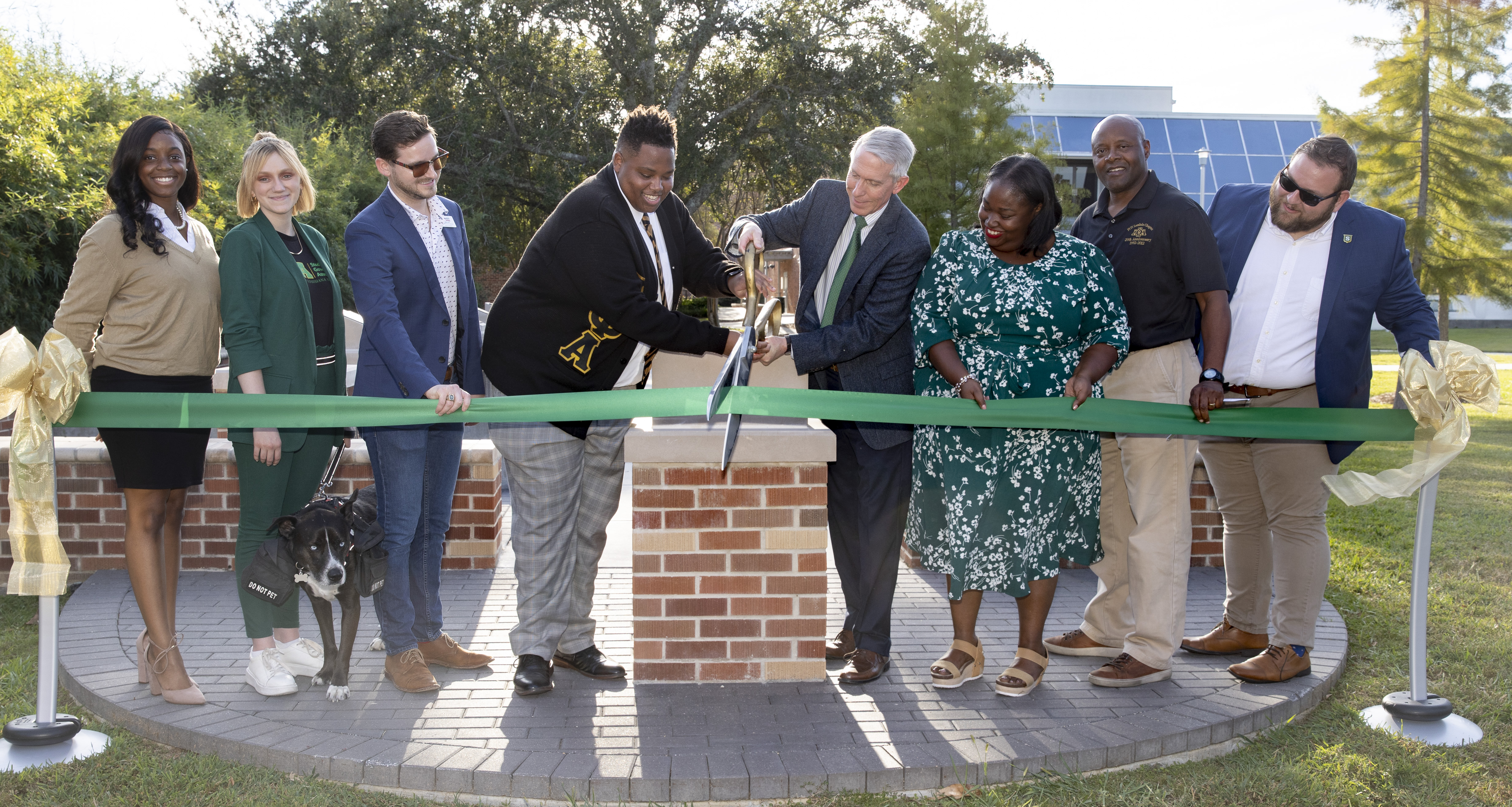
Southeastern recently honored these Black, Greek-lettered organizations, none of which previously had a dedicated physical spot on campus, with the construction of a plaza that marks each of the Divine Nine with a plot. These prominent monuments portray the historical legacy of the nine fraternities and sororities composing the NPHC.
A plot dedication ceremony was held at Student Union Park in Oct., 2022, during Homecoming Week. Southeastern President John L. Crain and members of the NPHC gathered together to celebrate the monumental project that had been in the works for five years.
The opening ceremony allowed members of the council to gather and celebrate their history as Black, international Greek-lettered organizations.
Southeastern joins universities across the world in advocating for and increasing awareness of these organizations. President Crain emphasized the importance of this monumental project that was first introduced by the 2017-2018 SGA President, Seth Leo.
“This is an important day for the University and our students,” Crain said. “This was one of the top projects he [Seth Leto] presented and said was a top priority for SGA. There were a few hiccups along the way, but we stayed the course. I’m very proud of the outcome.”
Southeastern students and community members are encouraged to visit the plots to learn more about the rich history of the National Pan-Hellenic Council, Inc. For more information regarding the NPHC, email nphc@southeastern.edu.



 southeasternmonthly.blog