Newspapers around the country were recently encouraged to run a prominent headline with a localized news story to remind readers how local newspapers, like Southeastern’s student-run weekly newspaper The Lion’s Roar, and their staffs share in the difficult circumstances and other impacts of coronavirus and COVID-19.
The Lion’s Roar chose to participate with a noticeable headline and story to include in their March 31 issue. Several Louisiana newspapers submitted their customized messages and designs to the Louisiana Press Association (LPA), the official trade organization for Louisiana news publishers. The Lion’s Roar was the only college newspaper in the state recognized by the LPA for their participation in the initiative.
“The editorial staff and I were thrilled to be a part of this initiative, keeping the community up to date on the most recent news regarding the pandemic,” said Editor-in-Chief Jacob Summerville, a junior political science major from Greenwell Springs. “We have had several stories concerning COVID-19 thus far, but this layout was great to include because of the unity among other news organizations in the state. Being one of the most heavily impacted states in the country, this was the best decision to include our contribution in providing a local twist on an international crisis.”
The Lion’s Roar staff have been working to produce original content to include in both the digital version of the weekly newspaper, along with content shared through the publication’s web and social media presence.
“This is a hard time for everyone in the community,” said Assistant Editor Prakriti Adhikari, a junior accounting major from Hammond. “There are many uncertainties and people are scared, but there are good things happening as well. Through our participation with the Louisiana Press Association to make a unified front page, we wanted to spread a message to the community that we are still together. We want our readers to know that The Lion’s Roar will continue to serve its readers.”
The Lion’s Roar is continuing with its weekly production efforts despite staff working remotely. Readers can access content produced by student staff reporters through Facebook, Instagram, and Twitter @lionsroarnews, and via the newspaper’s website, lionsroarnews.com.
Southeastern Professor of Organic Chemistry Jean Fotie was awarded a $265,000 grant from the National Science Foundation. The purpose of the grant is to develop greener and sustainable catalytic methods for the reductive functionalization of carbon dioxide (CO2).
“Reducing the emission of carbon dioxide, one of the most significant long-lived greenhouse gases, into the atmosphere is one of the major challenges of our time,” said Fotie, a resident of Ponchatoula.
Despite remarkable advances toward the capture and storage of CO2, Fotie believes that a large-scale transformation of the abundant and non-toxic feedstock into valued-added chemicals could provide an important incentive for CO2 recycling.
“More than the obvious environmental remediation, this approach will be like turning CO2 into cash, and there is no better incentive than that for the chemical industry,” Fotie explained. “Of course, this requires the development of practical and sustainable catalytic systems that can enable a streamline fixation and conversion of CO2 into useful chemicals, preferably via continuous flow industrial processes.”
“Dr. Fotie has been one of our most productive researchers for years, so it is no surprise that he has received this prestigious award,” said Dean of the College of Science and Technology Dan McCarthy. “It is not just the quality of the work that distinguishes his research, but it is the fact that he includes so many of our students in his research. This grant will not only help the scientific community, but will also lead to an outstanding educational experience for our students.”
“The project objective is to develop a better understanding of how a number of active precious metals on one hand, and less active but earth-abundant metals on the other hand, respectively nano-dispersed in a range of sol-gel-derived organically modified silicates, would behave toward the reductive functionalization of CO2,” said Fotie.
More importantly, Fotie said, these activities will provide a unique opportunity to create a research environment that combines three very different groups of students at different stages of their education, namely the high school students enrolled in Southeastern’s Math-Science Upward-Bound program, Southeastern undergraduate students, and Southeastern integrated science and technology master’s students.
“This distinctive learning environment is designed to enable the younger generation to mirror their future through the lenses of their observations and interactions with the advanced generation,” Fotie explained. “Hopefully, this amazing group of researchers will be able to develop a new catalytic system that can enable the conversion of CO2 into important chemicals, a method that could eventually find application in continuous flow industrial processes.”
A Southeastern Louisiana University senior majoring in occupational safety, health, and environment has been awarded a national scholarship from the Board of Certified Safety Professionals.
Alison Garaudy of Loranger received the $5,000 award based upon her cumulative grade point average, a submitted essay on why she entered the program, and her commitment to obtaining professional certification upon her graduation.
“This scholarship means a lot to me. It has made a substantial difference in helping to fund my education, and I am extremely honored to be a recipient,” Garaudy said. “It has also boosted my confidence and helped assure me that my hard work is paying off. I am happy to know that my voice has been heard and potential was found in it.”
As an anticipated December graduate, Garaudy wants to apply her newly acquired knowledge to making workplaces safer and more productive for current and future workers.
“With climate change being such a prominent issue, protecting the environment is also especially important to me, so I want to make sure any company I work for is environmentally conscious and doing what they can to protect future generations,” she explained. “I would love to incorporate more environmental sustainability into my life and work, and I am very interested in working abroad at some point.”
One of Garaudy’s biggest goals is to influence the safety culture around her.
“I hope to educate the people I work with, so they can have a better understanding of why we go out of our way to be safe, especially when it seems like extra hard work for nothing,” she said. “We all have the right to work in a safe environment where we can stay healthy, but it takes individual efforts to make that happen.”
The Southeastern OSH&E program was recently ranked among the top 20 best values in OSH&E programs in the country by the website collegevaluesonline.com. The ranking is based on quality of academics; value, which includes tuition affordability and financial aid; and the calculated average return on investment data, a guide to the success of students graduating from the program.
The website valuecolleges.com also ranked the program among the top 25 in the country in best value occupational safety and health degrees. The ranking is based on reputation, subject to U.S. News & World Report; return on investment, based on payscale data; and cost, based on online tuition as reported to the Integrated Postsecondary Education Data System (IPEDS).
The OSH&E program is nationally accredited by the Applied and Natural Science Accreditation Commission of ABET, Inc. The program grew from a two-year associate’s degree program to a four-year bachelor of science program following considerable input from managers at area industries who reported a significant need for safety, health, and environmental professionals. The program prepares students for a variety of positions, including roles of environmental safety and health specialists and safety supervisors.
The Southeastern Channel has won national acclaim for its coverage of the coronavirus impact on the Northshore.
Northshore News Update: Coronavirus on the Northshore has won a national College Coronavirus Coverage (CCC) Award given by the Society of Professional Journalists in conjunction with the Associated College Press; Society for News Design; College Broadcasters, Inc.; and the Foundation for Individual Rights in Education.
The Southeastern Channel was honored from over 700 entries from 258 universities across the nation as one of three broadcast winners for newscasts during the past month. Other winners were Cronkite News at Arizona State University and the Northwestern News Network at Northwestern University of Chicago. Honorable mentions were Annenberg Media at the University of Southern California, the University of South Dakota, and Appalachian State University.
The CCC Awards recognize excellence from college journalists for covering COVID-19 on their campuses and in their communities amidst campus closures and continuing online classes at home, said Southeastern General Manager Rick Settoon.
Settoon said the judges, all professional journalists including those from CNN, praised the Southeastern Channel as “expertly adapted to excel in this difficult climate, resulting in a strong, smooth newscast. They have been consistently good every week. The stories, the story choices, the diversity, the mix—all were excellent.”
“We’re extremely honored to be recognized as best in the nation by the prestigious Society of Professional Journalists, the world’s largest journalism organization,” said Settoon. “We’re so proud of our students who’ve stepped up big time to serve their communities during this crisis while having to complete online classes at the same time.”
The weekly newscast provides timely information on the coronavirus, specifically for Northshore residents. It is a condensed newscast that spotlights critical services for those in Tangipahoa, St. Tammany, Livingston, and Washington parishes provided by specific parish governments, school systems, hospitals, law enforcement, and business organizations.
The information provided spans everything from coronavirus testing and school food distribution to small business disaster loans. Also included are phone interviews with parish and state officials, such as parish presidents Robby Miller of Tangipahoa, Mike Cooper of St. Tammany, and Layton Ricks of Livingston, and state representatives Richard Nelson of Mandeville and Randal Gaines of LaPlace.
Others interviewed so far include Dr. Robert Peltier, chief medical officer for the North Oaks Health System, Director Bill Joubert of Southeastern’s Small Business Development Center, and Melissa Bordelon, CEO of the Greater Hammond Chamber of Commerce. Student reporters from the Southeastern Channel’s national award-winning newscast Northshore News have conducted interviews.
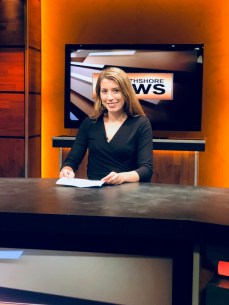
Lorraine Weiskopf
Lorraine Weiskopf of Covington covers St. Tammany Parish. Although she graduates in May, WXXV-TV Ch. 25 (FOX / NBC) in Gulfport, Mississippi, has already hired Weiskopf as a news reporter.
“I was thrilled to win this award, especially with many big-name universities placed alongside us,” Weiskopf said. “My team and I have put a lot of work into this, and I am so happy to see that it paid off.”
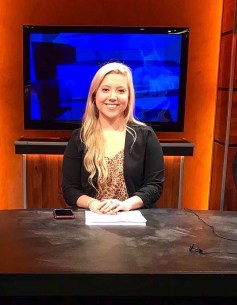
“I feel so honored to play a role in this program, and for us to win is another level of excitement because I know how hard we work each week to produce excellent content,” said reporter Gabby Cox of Hammond, who covers Tangipahoa Parish.
“To be up against so many other universities and college broadcasters and to come out on top is such an awesome feeling,” said Kaylee Normand of Mandeville, who covers Livingston parish for the show. “We have all put in so much time and effort to make every aspect of the shows perfect, and it’s really just rewarding to win this and see our hard work paying off.”
Since the students are forced to work from home during the pandemic, and thus are unable to shoot interviews and footage to avoid face-to-face contact, their reports lean on phone interviews and graphics with timely information in the form of websites, phone numbers, URLs, and times and locations of the vital services provided in each parish.
Gabby Cox
“This show is important because each week we strive to get the best and latest information to give to the people in our community,” Cox said. “The feedback that we receive from our viewers makes it all worthwhile because I genuinely feel like we are being helpful during a time that most of the world feels helpless.”
“We are gathering information about things that are happening within smaller communities on the Northshore,” Normand said. “Most news stations are covering things that are going on in the entire state right now, but I feel like we narrowed that down to particular parishes, and we are giving those residents all of the information about what’s going on in their backyards.”
“It takes a lot of extra work and a lot of phone calls throughout the day, but it makes for an interesting and informative show,” Normand said. “And that is the most important thing that residents need right now. They need to hear something that they haven’t already heard before.”
The students feel strongly that working on the coronavirus update in addition to the regular newscast provides real-world training that prepares them well for a career, Settoon said.
“Northshore News is fantastic because it allows you to take away as much as you put into it,” Weiskopf said. “It’s a student-run newscast that provides unlimited opportunities for us to develop shooting, writing, and editing skills for news. It also helps us understand the production necessary behind a newscast. When we create live shows, there are many opportunities to operate cameras, teleprompter, audio, and visuals. Students can learn everything so they can be well prepared for jobs in the TV news industry.”
New episodes debut at 4 p.m. each Friday and air throughout the day every day of the week on the Southeastern Channel, which can be seen on Spectrum 199 cable throughout the Northshore for a potential viewing audience of 250,000 in Tangipahoa, St. Tammany, Livingston, and St. Helena parishes.
Live streaming of the 24-7 Southeastern Channel broadcast can also be seen on Roku and Apple TV along with thesoutheasternchannel.com, which offers video on demand of all episodes. The Coronavirus update can also be accessed through the Southeastern Channel accounts on Facebook, Twitter, Instagram, and YouTube.
In its 17 years of existence, the Southeastern Channel has won over 400 national, international and regional awards, including 17 awards from the Emmys.
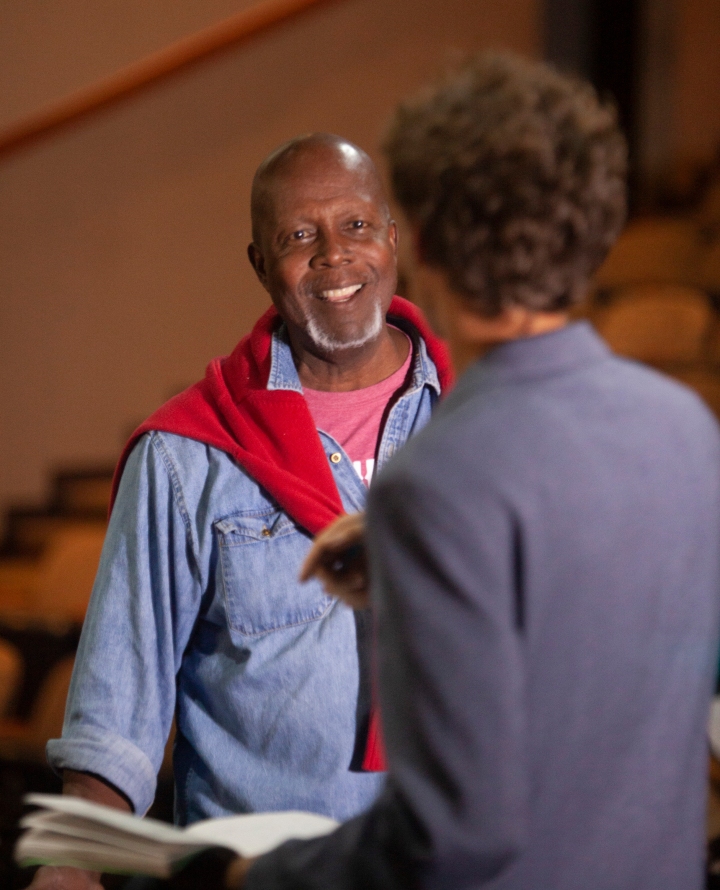
Whether or not you know him by name, you know Clarence Gilyard and his iconic work. Gilyard made his mark in some of the most popular TV shows of the ’80s and ’90s, including as James Trivette in Walker, Texas Ranger, Conrad McMasters in Matlock, and Benjamin Webster in CHIPs; performed in blockbuster movies such as Die Hard and Top Gun; and much more during his long, successful career as an actor, director, producer, author, and educator.
During the Fall 2019 semester, Southeastern theatre students had the opportunity to learn directly from the legendary actor. Gilyard, who is also currently an associate professor at the University of Nevada, Las Vegas, stayed on Southeastern’s campus in The Inn (the former President’s Residence) while teaching a class titled Acting for a Living as a visiting professor and guest directing the Vonnie Borden Theatre production of Anton Chekhov’s Three Sisters.
James Winter, associate professor of theatre and artistic director of the Columbia Theatre and Fanfare, was instrumental in bringing Gilyard to Southeastern. “Clarence and I met in 2013 while working on a film called The Beast which is now on Amazon Prime,” Winter said. “As a fellow artist and educator, we immediately hit it off. I wanted him to come to Southeastern as a guest artist and lecturer. He knew I wrote textbooks and wanted to collaborate on an acting book.”
Three Sisters cast members Sarah Easley (back row), Payton Core (front left), and Megan Blonquist (front right) with Guest Director Clarence Gilyard.
Three Sisters cast members Sarah Easley (back row), Payton Core (front left), and Megan Blonquist (front right) with Guest Director Clarence Gilyard.
The book that the two men are collaborating on will have the same name as the class that Gilyard taught at Southeastern—Acting for a Living—and aims to teach actors how to continue to grow, learn, and train when they are not in the classroom or in rehearsals, as well as help actors continue to develop their characters and grow as artists while in a long run or touring show.
Students were energized by the chance to learn from Gilyard, who helped them grow in their craft. “I certainly think he challenged our students with his approach and the difficulties presented by his choice of play to direct. Chekhov is tough stuff. He brings a lot of positive energy with him,” said Winter.
Stage Manager Amy Schneida also commented on how Gilyard’s time at Southeastern impacted students. “There was definitely a buzz of excitement amongst the students of the Theatre Department when Jim told us we would be having a special guest director that had Hollywood experience. All of our actors took this opportunity very seriously, but I noticed our veteran actors especially stepping up their game when it came to research and character analysis. However, I was most impressed by our newcomers to the department. A majority of our cast was composed of very young actors, with little to no prior performance experience under their belt. Watching them start from square one and grow to be on par with our veteran actors and actresses was absolutely phenomenal.”
While Gilyard’s term on campus is now over, the theatre program at Southeastern regularly brings in guest directors—enriching hands-on student learning through different perspectives and experiences, new challenges, and invigorating opportunities to learn from some of the best in the field.
Bats comprise 20 percent of Earth’s mammal population. As the second most populous species of mammals in the world, they have a profound impact on ecosystems across the globe—including the humans that are a part of them. Yet despite their prevalence, there is still much left to uncover about these fascinating winged little creatures.
By tracking them through an innovative system on the International Space Station (ISS) to small heartbeat monitors, one Southeastern professor is collecting valuable data that will help increase our understanding of the movements of these amazing animals—and their communications, social structures, and physiology. These efforts may contribute to a momentous impact on not only them and their environments, but humans as well.
Dr. Teague O’Mara, an assistant professor of biological sciences in the College of Science and Technology since the fall of 2019, specializes in integrative biology. Over the past few years, a large part of his research has focused on bat migratory patterns and behavior.
Part of this research has been conducted as part of an ongoing partnership since 2013 with the Max Planck Society, a renowned public German research organization that operates 84 research institutes, primarily in Germany but also across the globe. The Max Planck Society investigates a wide variety of topics, from plasma physics and optics to rust and plant genometrics. Sponsored by the German government and with a guiding principle of “insight before application,” the organization exists to make initial discoveries about the world.
O’Mara works directly with the Max Planck Institute of Animal Behavior—and currently in conjunction with an out-of-this-world research project that will help provide invaluable data on animal movements on Earth.
Icarus, an international collaborative effort led by the Max Plank Institute of Animal Behavior and in conjunction with the Russian space agency Roskosmos and the German Aerospace Center, utilizes an on-board computer and antenna on the outside of the ISS. It was installed during a spacewalk lasting nearly 7 hours and 46 minutes on August 15, 2018, by two Russian cosmonauts. Because of the extensive amount of power required by this type of system, it utilizes all of the ISS’s solar panels. After time spent working out technical issues and testing, Icarus is now fully functioning. Bats, and other animals, are tagged with monitors that keep track of the system on the ISS and transmit signals, allowing O’Mara and his fellow researchers to gain insight into their movements.
Russian cosmonaut Sergey Prokopyev lays cable for the installation of Icarus on the Zvezda service module of the International Space Station during a 2018 spacewalk. Image by NASA.
O’Mara has been continually tagging bats. He visited Zambia in late November of 2019 to catch and release more with different types of trackers. “Within the next year we’ll start getting really great data about them,” O’Mara said. “We already have some information about these animals, but especially with this new technology should have great data on how these animals are moving over a year or more. It’ll be really nice.”
To catch fruit bats for tagging, Teague O’Mara (left) and fellow team members shoot a rope over trees to hang a canopy net in tree gaps. Photo by Blair Costelloe.
While bats are at the heart of O’Mara’s interests and research, the knowledge that Icarus will provide extends to other animals. The project works really well for big species, such as elephants, lions, antelopes, and impalas, since larger animals allow for larger tracking devices. But it will also be used to investigate undiscovered migration patterns for smaller species, such as cuckoos that migrate from Europe to Africa and various types of birds that migrate across North America into Central and South America. “We don’t really know where they go,” said O’Mara.
“But one of the great things about this system is it gives us really cheap and detailed individual-level data about animals,” O’Mara continued. “We see flashes of birds when they’re coming in to migrate, for example, but we don’t know much about their individual stories. This will hopefully give us individual-level stories about how animals deal with life as they need to go from one place to the next.”
These individual-level stories are intriguing in their own right, but they can also lead to a greater understanding of their impact on humans and the world around us.
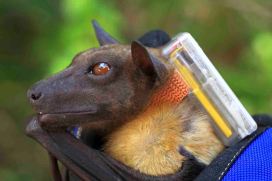
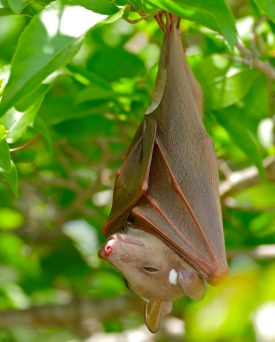
A GPS tagged straw-colored fruit bat is ready for release at Kasanka National Park, Zambia.
“If we know what one animal does, we can start scaling it to populations and can actually start understanding what impacts animals have as they move, especially across their migratory patterns,” O’Mara explained.
These impacts can be profound. As bats—which are the only mammal capable of true and sustained flight—move from place to place, they help spread seeds. This is essential for the replenishment of forests, and it also directly brings about a great benefit to humans.
In addition to wild landscapes, bats make important contributions to the urban areas they visit. “They’re spreading lots of seeds,” said O’Mara. “They’re bringing lots of trees up in to the area, which can be cut down for houses, provide lots of food, and even protect the water—they do a lot.”
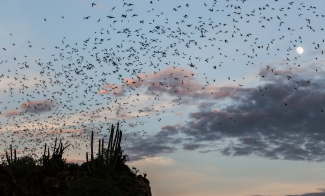
Since they feed on insects, bats also provide a great benefit to humans by providing a natural source of pest control. According to O’Mara, Brazilian free-tailed bats, for example, provide $20 million to $40 million worth of pest control for just the cotton and corn crops in the southern United States each year.
Unfortunately, the movement of some bats has been changing.
“What we’re starting to see is that the migration of these animals in a lot of places is starting to go away,” said O’Mara. “As climates change and temperatures start to even out, more places become profitable winter habitats. These bats only eat insects, and we’re beginning to see in some of the caves in Texas, for example, that they just don’t go anywhere because there’s lots of insects for them to eat there. So why would they move on?”
The collapse of such migrations can lead to a lack of forest revitalization and decreased pest control. “Corn crops get destroyed, and insects like mosquitos can go back up,” O’Mara said. “There are lots of things that can happen just from one animal not moving to another spot. It can also mean that forests don’t get regenerated as fast as they might have in the past.”
The data collected through Icarus and the tagging of these little animals will help increase our understanding of what bat colonies do for any given area.
Although Icarus and O’Mara’s research are concerned with obtaining the raw data, the information that is gathered will be immensely valuable for conservation initiatives. “We can hand the data over to someone else and give them ideas of what solutions might actually be there,” said O’Mara.
Teague O’Mara prepares mist nets to capture bats in a field in Germany. Photo by Christian Ziegler.
O’Mara is regularly asked for and provides data, which can be used to create actionable plans and educate the public, often by conservation agencies. “We try to give as much data out as possible,” O’Mara stated. “I get asked for information about environmental impact assessments a lot, especially for places where we’ve tracked animals—because all of the movement data we collect tells us how animals use the landscape.”
Some of the organizations that he works with through the Max Planck Society include Bat Conservation International in Texas, Bats Without Borders in Malawi, and Bat Conservation Africa.
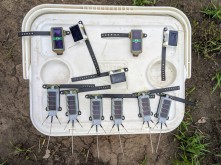
Small solar-powered GPS tags collect the position of bats and then send this information through mobile phone networks to the data repository Movebank.
In addition to O’Mara’s work with Icarus, and the powerful impact that it may be a part of in the coming months and years, there are additional intriguing aspects about these little creatures—the most diverse group of mammals on the planet—that the Southeastern professor studies.
One of these fascinating areas of study regarding bats is the complex relationships and communications that the animals develop with each other, to which their long lifespans contribute. Only 19 species of mammals on Earth live longer than humans for their body size, and 18 of those are bats.
In one location that O’Mara has studied, groups of unrelated females, each with its own dialect of calls, will regularly meet in the same spot at the same time over their 20-year lifespans, migrating from different locations. Not only are they communicating in the dark across huge distances, but their extended lifespans cause them to form sophisticated relationships.
“Humans have a lot of social and cultural support that keeps our lives going for a long time, and bats seem to show similar things too,” commented O’Mara.
In fact, the function of these social relationships in very large colonies is one area in particular that O’Mara would next like to investigate. There are roughly 2 million bats that live in Bracken Cave in Texas and 10 million where he works in Zambia, for example, “and all of these bats live for a long time and come back to the same places over and over—they have to have buddies there,” he said. “There are probably some small social groups that work within these areas, but we don’t actually know what they do. And it’s probably that these social groups are one of the keys to their really long health spans. They almost never get sick. They just keep going forever, and then they disappear. It’s really intriguing to me that we don’t know something so important about them, but it’s probably one of their key aspects.”
An interest in the social structures is also what initially led O’Mara to begin studying bats. His earlier research and Ph.D. focused on primates, particularly lemurs in Madagascar. As he was considering in what direction he should next take his research, he realized that many of the social questions he was interested in with primates also translated well to bats. He then transitioned into working in a bat lab in Panama. “And once I started working on bats I got hooked,” he said.
It was also in Panama that O’Mara once tracked a group of large bats that somehow found an island of flowering trees, which they would regularly visit on a 20-mile journey from their own island, crossing ocean. “How do you find this? How do you manage to do this?”, O’Mara asked amazed. “That island is in the middle of an industrial banana field—there is nothing good in that place. It’s full of nasty pesticides, there’s no other food for them in there, and they just had to fly across an ocean (which has nothing for them) and this ocean of bananas (which has nothing for them) to find this little flowering island. And they would go there for an hour and then go back home to their cave.
“Every time you do a study like this it’s totally surprising,” he continued. “Somehow there must be some type of cultural transmission. Without tracking these animals we never would have found such unusual behavior.”
But as interesting as this is, O’Mara said that his favorite study has been monitoring a bat’s heartbeat as it went about its night. “I study a lot about physiology, and I use heartbeats to tell me a lot about the way animals use energy and what they are doing. But the coolest thing I’ve ever done is chasing a small bat around in the forests of Panama listening to its heartbeat,” he said. “We attach a lot of emotion to our own hearts and heartbeats. Our heartbeats speed up when we get excited, slow down when we become calm—you can hear that in an animal too.”
O’Mara tagged bats with a small device that recorded and transmitted the sounds of their heartbeats as beeps. Through this he was able to gain insight into the nightly activities of individual bats, from following along with their speeding heartbeats as they felt fear or flew through the night sky to listening to their slowed beeps as they settled down.
This not only created an awe-inspiring feeling from the personal connection, but also led to increased knowledge about the unique mechanisms that these bats use for conserving energy. The lowering of heart rates at regular intervals in order to save energy during the day is one such adaptation.
“Bats have different kinds of social structures and physiology to make sure that they can run their life at the speed of a Ferrari, but then slow it down as well. They can go between these two effortlessly,” said O’Mara. “To me that’s kind of amazing.”
Teague O’Mara displays the wing of a common noctule bat in Switzerland. Photo by Kamran Safi.
Uncovering and interpreting such information—from their movements and communications to their social structures and physiology—not only contributes to a greater scientific understanding of bats, but it can also provide a different lens through which we see these amazing animals. We are able to glimpse in them something of our own selves, forging connections between us and these little mammals.
This association, along with the information gathered on the impact that they and their movements have, can help disband ingrained fears and increase our compassion and concern for them—and for the world around us. As the data currently being collected by O’Mara and his colleagues is applied and the resulting conservation efforts embraced, ecosystems, bats, and humans will all benefit.
Students at Southeastern also now have a direct opportunity to relate to and gain a greater understanding of not only bats, but all of the animals in their local natural environment while additionally acquiring hands-on experience. “With the mammalogy class I taught last semester we had a big camera trapping project in North Oak Park, which was super cool because it actually gave us a much better understanding of what mammals are around Southeastern’s campus,” he said.
The diversity rate they found was much higher than had been previously thought. Red foxes, possums, armadillos, bobcats, grey foxes, and coyotes were among the animals his students were able to identify and monitor roaming through the area.
Interestingly, Louisiana as a whole is also actually one of the most diverse states for bats, hosting many as they migrate from the North. Many of these, including the common free-tailed bat, roost in trees or barns and are most easily seen over ponds and lakes, where they can feed on insects and have access to a water source.
O’Mara, who commented on how much he has enjoyed the enthusiasm and support from both his students and department during this academic year, his first not only at Southeastern but also in Louisiana, has plans to expand student research opportunities in the future. One of these upcoming initiatives will be a tracking project at Turtle Cove that will provide a great way for many students to gain research experience in the field, as well as serve as an interesting long-term study relating to a timely topic—our changing wetlands.
While teaching at Southeastern and engaging the next generation of possible scientists, O’Mara continues to pursue his intriguing research on bats and their relationships with each other and their environments, as well as remaining active with Icarus and collecting the far-reaching raw data that it will provide over the coming months.
By Sheri Gibson
Bonus Clip: Click here to hang out with Teague O’Mara as he explains how fruit bats are restoring African woodlands in this short Max Planck Society video.
As the pandemic of COVID-19 continues, college students and faculty all across the world are continuing to put forth an effort to finish the spring semester the best way they can—despite all the challenges and distractions surrounding them.
The same can be said for the Southeastern community. Faculty members have been working religiously to provide the best support and quality education possible for students through remote instruction to help protect them from the terrible health effects of the pandemic.
One faculty member in the Southeastern community who has been adapting and maintaining positivity throughout this global crisis is Workforce Talent Initiative Technology Recruiting Manager Sandy Summers.
“Prayer and fresh air,” said Sandy. “Focus on the positives.”
Summers has been serving in her manager position since last January, working in the College of Science and Technology’s new Workforce Talent Initiative.
“Our goal is to create a pipeline that connects our students in science and technology to quality job opportunities and address workforce needs in the tech space,” said Sandy.
Because her job role involves career development, she normally spends a lot of time collaborating with the Office of Career Services on campus, often meeting with students and companies there.
“My duties toggle from a student focus to employer focus,” said Sandy. “I work with students to ensure they are “work ready” and prepared to enter the job market. There are a lot of graduates looking for work, so I want to make sure our Southeastern students stand out in a crowd of job applicants,” she said.
From the employer focus perspective, Sandy is responsible for making sure employers are aware of Southeastern students and academic programs that will help students that fit their hiring needs.
“I try to identify new processes / technologies in industry to ensure our students are being exposed to critical knowledge they will need in the workplace,” said Sandy.
As for her adjustment to working from home during the pandemic, Sandy has adapted well from a technological perspective, which could be from her knowledge of technologies and her job to stay up to date on new tools and advancements.
“My new best friends are Google Meet, Zoom, and Skype,” said Sandy. “One of the first webinars I attended when I transitioned to my home office was one hosted by Google with a ton of tools for working from home. As long as I have a way to connect with students and employers, I’m OK,” she said.
One of the other adjustments Sandy has had to deal with is maintaining a balance between work and family life.
“My daughters are home as well and I am trying to keep them on a schedule that includes classwork, chores / life skills, and exercise,” said Sandy. “I have to make sure I’m attentive to their needs, so I have to schedule in breaks to make sure they are OK,” she said.
Sandy shared how her department is continuing to provide students with the same level of quality education and services from home. “Our changes are not significant in my opinion,” she said. “The delivery is a bit different, but the mission is the same. I will say overall it will have a positive impact on our department because we are being forced to embrace technologies we otherwise might not have adopted,” she said.
A lot of reports in terms of education have been written about how COVID-19 will affect education from the student perspective. When it comes to the faculty perspective at Southeastern, Sandy discussed that the pandemic has forced the faculty to level up at a fast pace when it comes to adjusting.
“It’s 2020,” said Sandy. “There are creative solutions to address some of the delivery issues some have described. It’s just a matter of identifying the issue and adjusting and adapting to it. It feels like this has been going on forever, but it’s only been a few short weeks. We have accomplished a lot,” she said.
The transition to online learning has been a challenge for some students and even faculty. One concern involving online learning is that some faculty have not had experience teaching online. While some may look at this as a drawback, Sandy disagrees.
“I don’t really see it as a setback,” said Sandy. “It’s a learning curve. Our faculty have been forced into a new way of doing things very quickly with no guidebook or manual,” she said.
As for universities having huge enforcements of online teaching and the continued use of online resources for faculty, Sandy said that it’s an absolute requirement. “It’s a must,” said Sandy. “Now that we have experienced this crisis, we cannot move forward without preparing ourselves for the next “what if,” she said.
For the impact that the pandemic has created and will have on future semesters, Sandy explained that she continues to believe that everyone will come out stronger with a fresh outlook.
“I feel for those that have been directly impacted by the virus locally and globally,” said Sandy. “I choose not to dwell on the negative and to focus on the positive results of the pandemic. Stronger connections, value of family and friends, self-reflection, self-care, etc. I have faith that this will pass, and we will come out of this with a new and better perspective,” she said.
The Southeastern Connect business directory is the Alumni Association’s newest platform feature. Here, alumni business owners can showcase and promote their businesses to other graduates for FREE! Business profiles provide platform users an in-depth description of the business’s operations and accurate contact information. There’s even an option to message the owner directly through our platform, and unlike other websites or social media platforms, users can be confident about who is receiving their questions, comments, or concerns because each business account is directly linked to an individual profile.
Listed businesses have the option to extend exclusive offers to fellow alumni that are completely customizable for each business. Whether it’s a discount, a special add-on to a purchase, or something even more unique, all users can access and benefit from these offers that are exclusive to the platform. Users can also enjoy an easy search option based on business name or geographic location that makes finding businesses a breeze.
During this time of uncertainty and financial loss, we need to support our alumni, friends and community more than ever. We are excited for the opportunity to give our alumni owned businesses a platform that allows their business to shine!
Getting started is easy! Simply visit southeasternconnect.org to create your personal account if you don’t have one already. Once you have your own profile, you’re ready to register your business in our directory. Don’t own a business? We invite you to support your fellow alumni by creating a personal account, searching the directory for local businesses, and enjoying special offers and benefits! We’ll see you online, Lions!
Southeastern’s summer semester tuition is being reduced as part of its new Summer Online effort. A $300 credit will be given to all summer students, both undergraduate and graduate, and will be placed on fee bills. This credit will significantly lower the overall cost of attendance this summer. It also effectively makes the cost for most undergraduate students less than $325 per credit hour.
By extending this tuition reduction to graduate students, Southeastern hopes they will take advantage of the online semester offerings as well.
For those who are not currently students, Southeastern is providing another incentive to try Summer Online. Throughout the month of April, all application fees will be waived for students who apply to Southeastern during the summer or fall semesters.
Along with the financial cost reduction, the online instruction and wide availability of offerings allow students to more rapidly advance their degree progress while addressing COVID-19 concerns over in-person contact, helping students to better focus on their studies while helping ensure their health and safety. Credits can be earned remotely in as little as one month.
By providing the flexibility that online courses offer, more students are able to take courses at Southeastern during the summer semester. When offered in the past, this format has been embraced by both traditional and non-traditional students alike. High school students and students from other universities, who may live too far away to easily commute, are likewise encouraged to take advantage of the program and rapidly advance toward their degree.
This innovative new Summer Online initiative is part of Southeastern’s ongoing commitment to remaining one of the best values among four-year colleges in the region—providing an affordable, high-quality, and supportive education centered around the needs of today’s students.
Priority registration for the summer term is now open, with regular registration beginning April 10 and classes kicking off on June 3.
Southeastern’s spring 2020 in-person classes ended on Friday, March 13, due to COVID-19 precautions, but the academic progress of students continues.
On Wednesday, March 18, the university transitioned to online instruction. The process has been fluid and has seen great results, with both faculty and staff quickly adapting to the changes.
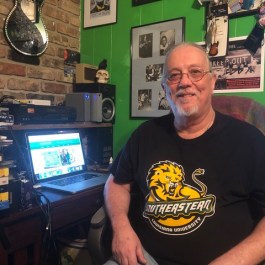
“Although I would much prefer to teach my classes in person, particularly because they were very good classes this semester, adapting to online instruction and work from home has gone smoothly,” said Professor of History and Department Head Dr. William B. Robison. “As Department Head of the Department of History and Political Science, I am very fortunate that most faculty in the department have taught online classes and that the few who have not done so were quick to seek assistance from the Center for Faculty Excellence or tech-savvy graduate students.”
Southeastern’s Center for Faculty Excellence began preparing for the move in advance of the first day of fully remote learning and continues to offer a variety of tools to aid Southeastern educators.
“When the transition was announced, the center’s goal was to create a basic set of resources to help those that needed it most,” said Dr. Mary Ballard, the center’s director. “Basic information was presented in on-campus workshops before the university closed and afterward using live streaming and recorded webinars.”
The suite of resources the center has made available includes a revised webpage that guides faculty through a four-step process for transitioning to the online environment; one-on-one online assistance; live, live streaming, and recorded webinars as well as PDF guides focused on utilizing Google Meet, Moodle (Southeastern’s learning management system), PowerPoint, YouTube, and more; Faculty PRIDE Podcast that connects voices across campus on professional development topics; and a Care and Share Google Group that allows faculty to come together and share their experiences, facilitating assistance and advice from colleagues.
“You can’t just put a face-to-face class online,” said Ballard. “Learning objectives have to be re-examined, and new ways of achieving them are often needed. Activities that work well in the physical classroom may no longer work in the virtual one. Our workshops and one-on-one time helped those struggling with this concept. This is ongoing.”
“The COVID-19 crisis has been a challenging mixture of devastation and uncertainty, but faculty are doing their jobs,” said Robison. “We take a lot of pride in doing it right.”
“I have noticed students, faculty, and staff responding with grace, understanding, flexibility, and kindness. This is one of the many reasons I love Southeastern so much,” said Erin Rode-Fiorello, instructor and undergraduate coordinator for the General Studies Program. “I’ve witnessed amazing changes and growth that all universities experience, but at the heart of our university is the community and family that is Southeastern. The support and help that is given to each other through whatever may come our way, be it 9/11, a hurricane, a flood, or COVID-19, we get through it together.”
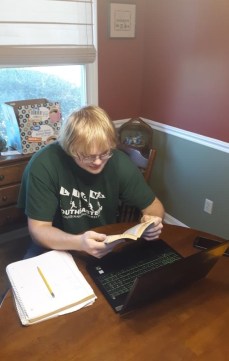
Bradley Miller, a computer science major from Paducah, Ky., said his instructors have been nothing but supportive, and that technology has helped in explaining concepts.
“My English teacher is really good at telling us what direction we should be heading and how we are doing on our assignments,” he said. “And my math teachers are either posting videos of practice problems or PowerPoint lecture slides.”
In addition to the Center for Faculty Excellence, Southeastern houses the Center for Student Excellence. The center works with first-year students, transfer students, and students that are uncertain about their major and / or career, as well as offering tutoring and supplemental instruction for all students at Southeastern. The Center for Student Excellence Director Dr. Lorett Swank said that spring is normally a bit slower pace for the center but, ironically, they have been focusing on professional development with weekly training in Leonet, Moodle, and Google programs like suite, meet, calendar, and sheets.
“We had no idea that we were actually preparing for something like this. A shared Moodle shell had already been developed for our classes with a week-by-week curriculum making the transition to on-line seamless,” Swank explained. “We were already using the Google drive to store and share important documents and all CSE staff were using the Google calendar to schedule student appointments.”
The biggest challenge, Swank said, was trying to figure out how to transition the tutoring and almost 3,000 advising appointments to an on-line format.
“Luckily, we have some really smart, creative, and dedicated people who are able to work under pressure and think outside of the box,” she said. “The days before we were sent home it was a bit of a scramble with multiple last-minute urgent meetings requiring us to change directions as new information became available.”
In the days leading up to March 18, Swank said she had all CSE staff inventory their home technology and encouraged them to get their home workspace in good working order.
“We made a quick order to get webcams, and they began selling out everywhere,” she said. “I also asked all CSE staff to be Google Meet proficient, and we were able to practice at the office before we all left. We even held a meeting in the office via Google Meet so everyone could get the hang of it.”
The Tutoring Center tutors also practiced sessions with Google Meet, and they were able to successfully navigate the software and establish a system that students can drop into tutoring sessions by subject via the website, Swank explained. Students are currently meeting live with tutors in select subjects.
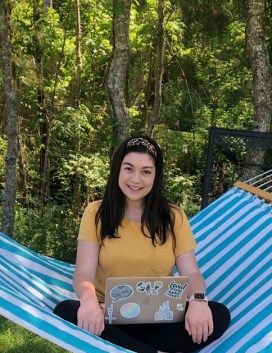
“This is a great opportunity for students to stay connected with Southeastern, and it is available for all undergraduate students,” said Brooke Giaratano, a Communication Sciences and Disorders graduate student and Tutoring Center graduate assistant. “Students can access many resources for remote learning during this time.”
The center also perfected on-line advising in Google Meet, where students can view an advisor’s schedule and make an appointment. Since remote work began, Swank said, the center has successfully advised over 800 students to date with the new system.
In addition to changes with advising and tutoring, the center is also launching a new chat feature on their website. During normal business hours, anyone can chat with CSE staff via a link on the website.
The center is also using Instagram Live, where two staff members are featured on Mondays with an “ask me anything” format to help students with whatever is happening in their academic life, and creating videos for commonly asked questions pertaining to advising, registration, and other topics related to student success. They even have their own YouTube channel.
According to faculty, students have been adapting well to the transition and demonstrating commitment to their studies. Robison commented that his “students all have taken the situation in stride. Of course they are not thrilled at the threat COVID-19 poses, and most of my students have told me they miss the face-to-face contact, but they have not complained or neglected their work.”
“Overall, although this is not an ideal situation, I feel that I have adapted well to the changes that COVID-19 has brought,” said Giaratano. “I plan to continue to work hard in my classes and make the best of this situation.”
“I know that this is a challenging time for everyone, but the silver lining here is that it has forced us to create new student-friendly systems, giving our students real-time information and easy access,” Swank explained. “It is something that we have struggled with for a while in higher education and this is the perfect opportunity to evolve. While we are apart trying to flatten the COVID-19 curve, we are increasing our learning curve to help our students be successful.”


 Stage Manager Amy Schneida also commented on how Gilyard’s time at Southeastern impacted students. “There was definitely a buzz of excitement amongst the students of the Theatre Department when Jim told us we would be having a special guest director that had Hollywood experience. All of our actors took this opportunity very seriously, but I noticed our veteran actors especially stepping up their game when it came to research and character analysis. However, I was most impressed by our newcomers to the department. A majority of our cast was composed of very young actors, with little to no prior performance experience under their belt. Watching them start from square one and grow to be on par with our veteran actors and actresses was absolutely phenomenal.”
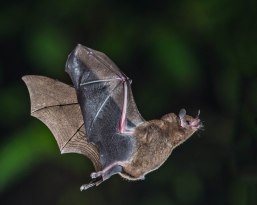 Dr. Teague O’Mara, an assistant professor of biological sciences in the College of Science and Technology since the fall of 2019, specializes in integrative biology. Over the past few years, a large part of his research has focused on bat migratory patterns and behavior.

 Since they feed on insects, bats also provide a great benefit to humans by providing a natural source of pest control. According to O’Mara, Brazilian free-tailed bats, for example, provide $20 million to $40 million worth of pest control for just the cotton and corn crops in the southern United States each year.
 In fact, the function of these social relationships in very large colonies is one area in particular that O’Mara would next like to investigate. There are roughly 2 million bats that live in Bracken Cave in Texas and 10 million where he works in Zambia, for example, “and all of these bats live for a long time and come back to the same places over and over—they have to have buddies there,” he said. “There are probably some small social groups that work within these areas, but we don’t actually know what they do. And it’s probably that these social groups are one of the keys to their really long health spans. They almost never get sick. They just keep going forever, and then they disappear. It’s really intriguing to me that we don’t know something so important about them, but it’s probably one of their key aspects.”
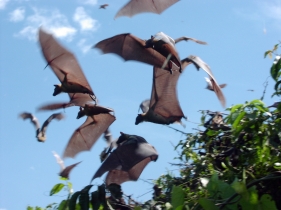 It was also in Panama that O’Mara once tracked a group of large bats that somehow found an island of flowering trees, which they would regularly visit on a 20-mile journey from their own island, crossing ocean. “How do you find this? How do you manage to do this?”, O’Mara asked amazed. “That island is in the middle of an industrial banana field—there is nothing good in that place. It’s full of nasty pesticides, there’s no other food for them in there, and they just had to fly across an ocean (which has nothing for them) and this ocean of bananas (which has nothing for them) to find this little flowering island. And they would go there for an hour and then go back home to their cave.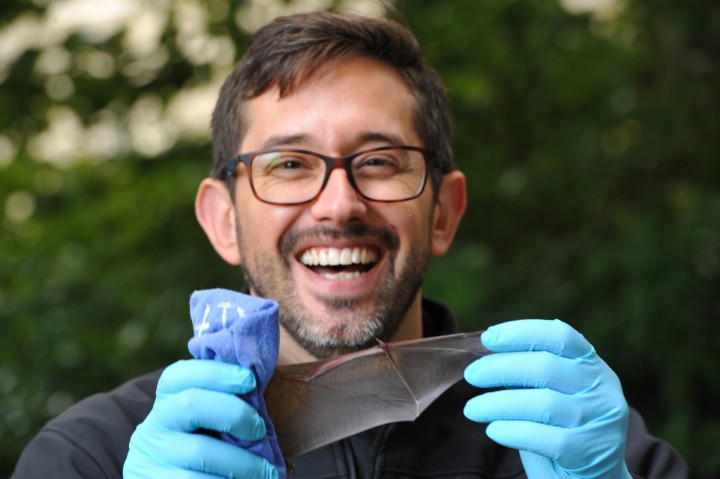
 Students at Southeastern also now have a direct opportunity to relate to and gain a greater understanding of not only bats, but all of the animals in their local natural environment while additionally acquiring hands-on experience. “With the mammalogy class I taught last semester we had a big camera trapping project in North Oak Park, which was super cool because it actually gave us a much better understanding of what mammals are around Southeastern’s campus,” he said.
 O’Mara, who commented on how much he has enjoyed the enthusiasm and support from both his students and department during this academic year, his first not only at Southeastern but also in Louisiana, has plans to expand student research opportunities in the future. One of these upcoming initiatives will be a tracking project at Turtle Cove that will provide a great way for many students to gain research experience in the field, as well as serve as an interesting long-term study relating to a timely topic—our changing wetlands.
 “Although I would much prefer to teach my classes in person, particularly because they were very good classes this semester, adapting to online instruction and work from home has gone smoothly,” said Professor of History and Department Head Dr. William B. Robison. “As Department Head of the Department of History and Political Science, I am very fortunate that most faculty in the department have taught online classes and that the few who have not done so were quick to seek assistance from the Center for Faculty Excellence or tech-savvy graduate students.”
 The suite of resources the center has made available includes a revised webpage that guides faculty through a four-step process for transitioning to the online environment; one-on-one online assistance; live, live streaming, and recorded webinars as well as PDF guides focused on utilizing Google Meet, Moodle (Southeastern’s learning management system), PowerPoint, YouTube, and more; Faculty PRIDE Podcast that connects voices across campus on professional development topics; and a Care and Share Google Group that allows faculty to come together and share their experiences, facilitating assistance and advice from colleagues.
 Bradley Miller, a computer science major from Paducah, Ky., said his instructors have been nothing but supportive, and that technology has helped in explaining concepts.
 “This is a great opportunity for students to stay connected with Southeastern, and it is available for all undergraduate students,” said Brooke Giaratano, a Communication Sciences and Disorders graduate student and Tutoring Center graduate assistant. “Students can access many resources for remote learning during this time.”
 southeasternmonthly.blog