Southeastern Instructor Alison Pelegrin Awarded Atlas Grant

Southeastern Louisiana University English Instructor and nationally- recognized poet Alison Pelegrin has received a $34,000 Awards to Louisiana Artists and Scholars grant to fund the completion of her fifth poetry collection Feast Days. A sub-program of the Louisiana Board of Regents Support Fund’s Research and Development Program, ATLAS is designed to provide support for major scholarly and artistic productions with potential to have a broad impact on regional and/or national levels.

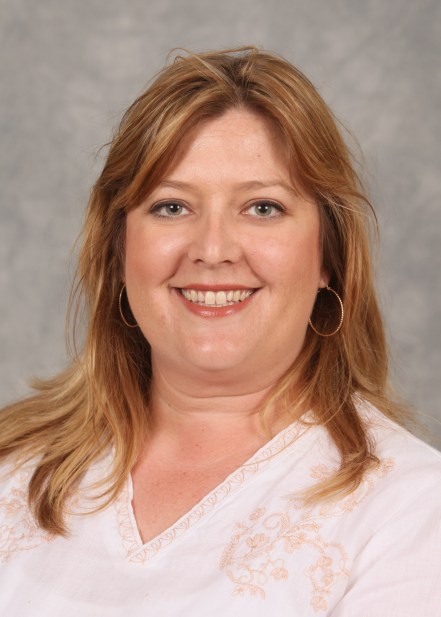
Alison Pelegrin
Alison Pelegrin

Poems from Pelegrin’s in-progress manuscript have appeared in top-tier journals, such as Image: Art, Faith, Mystery, The Southern Review, Tin House, and The Cincinnati Review.

“The Louisiana Board of Regents has granted me the triple crown – validation of my work, substantive financial support, and the precious resource of uninterrupted time to probe the issues I am writing and thinking about,” she said. “Reviewers have often noted the importance of Louisiana in my work, and for my beloved state to reward me in this way is a great honor. I am so grateful. I still can’t believe it is real.”

Pelegrin said Feast Days celebrates Louisiana and its cycle of destruction and rebirth on spiritual, political, racial, and environmental spectrums. Her work, she said, comes from a world of floods, of cars washed away, of fish swimming in streets and shoes bobbing in closets.

“I grew up in the shadow of New Orleans, on the West Bank of the Mississippi River, meaning that mansions and oak trees and seersucker society were just out of reach thanks to the barriers of water and wealth,” she said. “The tension of an outsider’s existence made my work spiritually rich, alive with the voice of lived experience. Poetry has never been more essential in a region that struggles to survive ecological and social catastrophes so often caricatured by outsiders with their drop-in scorn dressed up to look like concern.”

Pelegrin hopes to attend a two- to four-week residency at a writer’s colony and has plans to travel to more regional destinations, including Whitney Plantation, the Civil Rights Museum in Montgomery, Ala., and the sites where Confederate statues once stood.

Pelegrin is also the author of Waterlines, Hurricane Party, and Big Muddy River of Stars. In 2007, she was awarded a creative writing fellowship from the National Endowment for the Arts.

Lion of the Legislature

SLU010 FALL-2016-Inside-HR.indd

It’s not about building relationships. Merely knowing people doesn’t cut it.

It’s about building friendships.

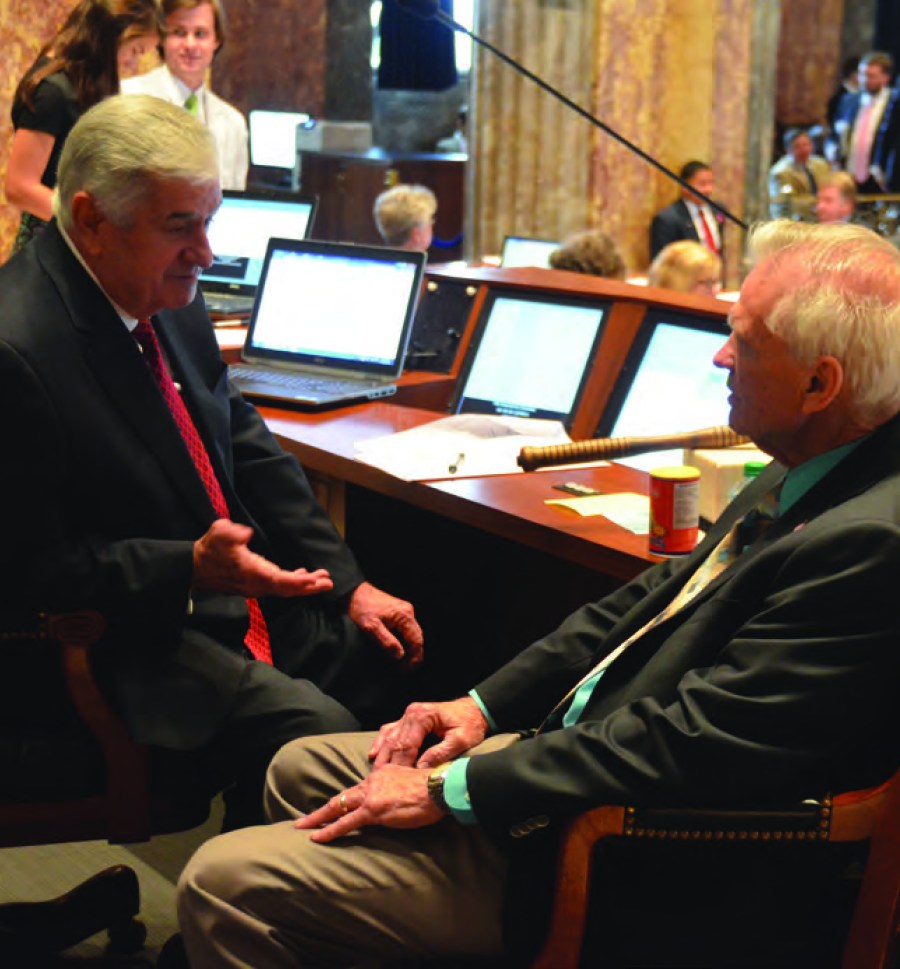
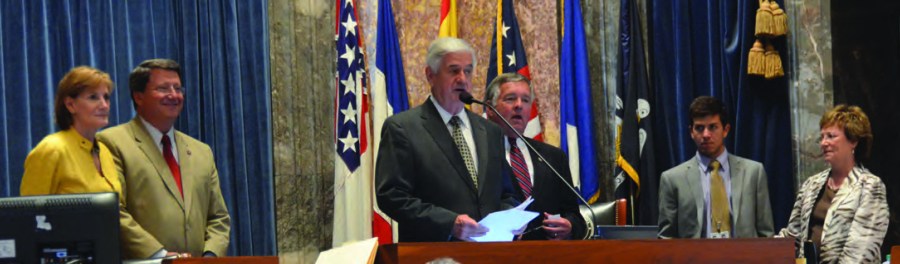
If anyone should know what it takes to be an effective public servant, it would be John Alario Jr. His 45 years in elected office include nine terms as State Representative (District 83) and, once term limits were instituted, three terms as State Senator (District 8). They also include two terms serving as Speaker of the House (1984-1988 and 1992- 1996), as well as two consecutive terms as Senate President (2012–present). Only four others in public service in the nation have held the top leadership roles in both their states’ House and Senate chambers. He has also earned the distinction as the only Louisiana Legislator to serve twice as Speaker and twice as President.

Needless to say, his political credentials are off the charts impressive.

So, how does the son of a commercial fisherman from Westwego climb to such political heights?

He’ll tell you it’s due to Southeastern Louisiana University.

Recruiters from Southeastern traveled to West Jefferson High School in 1961 and brought with them several current students who were West Jeff alumni. They made an impression with a young John Alario who said he had always heard great things about Southeastern. Knowing other West Jeff students who were “good guys” who went there sealed the deal for him.

Well, that and the fact that the school was far enough away yet still close enough to make it home on weekends to visit “my girl (his future wife Ree).”

“I learned solid academics and how to make real friendships,” he said. “Unlike kindergarten, when your mom drops you off and the only expectation is for you to get along with everyone else, this was my opportunity to meet people and make friendships based on trust, respect and appreciation of each others’ viewpoints.

“Those friendships made at Southeastern taught me that people always have more in common than they don’t,” he added. “Over time I learned from them that all people cry when their children hurt. They weep when their parents pass. And they all want things to be better for their own children when they grow up.”
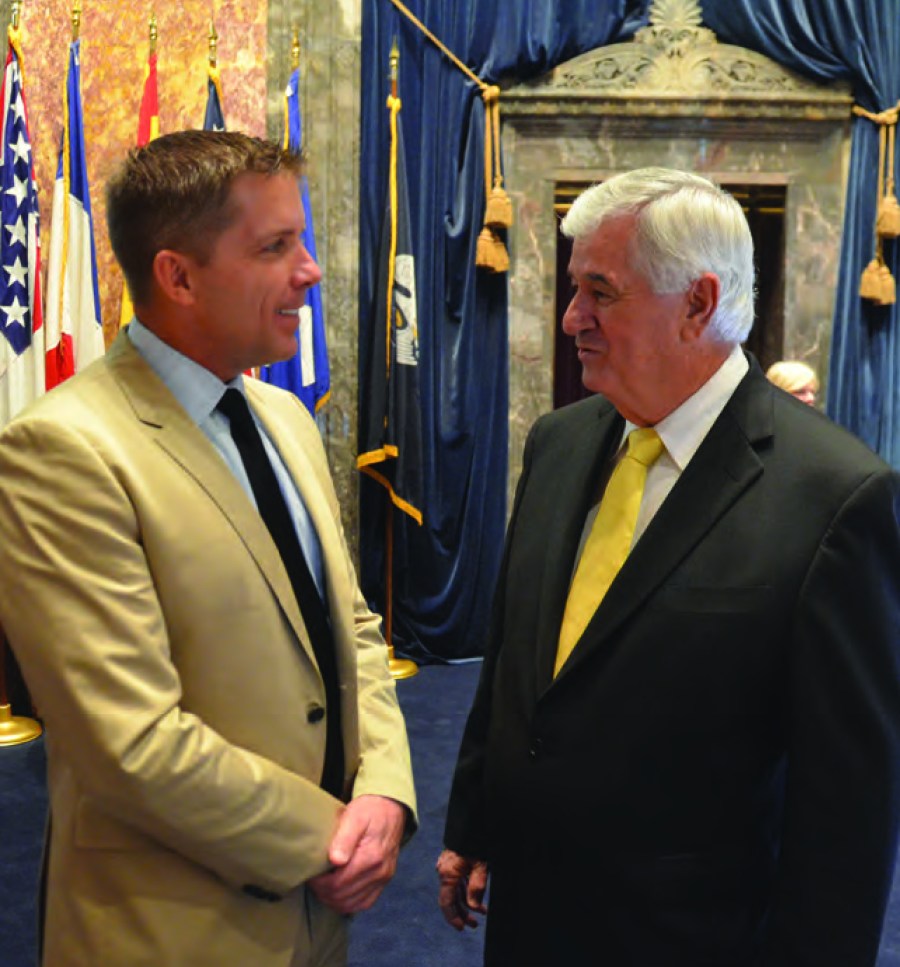
SLU010 FALL-2016-Inside-HR.indd

THE OPERATOR
Alario has been described as someone who wins votes by winning friends—an excellent listener with an exceptionally calm demeanor even in the face of some of Louisiana’s most “passionate and colorful” elected officials.

“There are always two sides to every issue—sometimes three sides. I listen to all the sides so we can find a way to mold them together,” he said. “Everybody’s got to be willing to give a little for democracy to work. That’s part of the problem with what we’re seeing today. People are digging in and unwilling to give anything.”

He added that you’ve got to know the rules and work within the rules. Now, make no mistake: that doesn’t mean he’s a political pushover by any means. In fact, the phrase “timing is everything” lends itself very well to a vote back in 1992. Alario had caught wind of a planned attempt to pull one over on the supporters of legalizing a land-based casino in New Orleans. The plan was for opponents to provide false assurance of its passage. Those against the measure would indicate votes in favor on their voting machines, but planned to switch their votes in the final seconds of voting. This would likely lead some legislators who were in favor—but would rather not have to take the vote on record — think it was destined to pass even without their votes. They wouldn’t vote because they thought their votes weren’t needed, and when the opponents switched their votes against it, it would fail. With no specific amount of time for voting prescribed in the House Rules of Order, Alario simply sped up his delivery of the call for votes—after having privately notified the staff that his calls for votes may be more rapid than usual that day. The voting closed before those planning to switch had a chance to do so, and the measure passed.

He was criticized for his swift delivery, but it was well within the rules of legislative engagement.

Of course, anyone in the political spotlight for such a lengthy duration will receive his or her fair share of disparagement from time to time. However, his colleagues will tell you he eventually wins over even his sharpest critics with his self-effacing style, his desire to find middle ground and often even his culinary acumen.

“If someone votes against something I support, I want to understand their reasons,” he said. “I’ve found that inviting them over to the Barracks for dinner at the President’s Apartment and enjoying an adult beverage or two with them helps us open up the conversation and better understand each others’ sides.”

What’s for dinner? Crawfish etouffee and chicken stew with lima beans are two of his specialties.

Whether over a seafood supper or in the hallways and meeting rooms of the Capitol, Alario practices his belief that one must first listen in order to learn. In fact, in the early 1990s, he was in the position to help facilitate greater opportunity for legislators to hear from the people of Louisiana. So that the public would be able to provide input and better engage with the state’s legislative process, he directed the construction of additional committee meeting rooms at the State Capitol. The House of Representatives applauded him for his foresight by unanimously passing a resolution naming the addition “Alario Hall.”

His penchant for paying attention to all parties involved has earned him a reputation as someone who will give you his word, and, most importantly, keep it. Trust is an invaluable commodity. It’s something he picked up from his Uncle Antoine who was an ice boat runner “back in the day.”

“The fishing crews would stay out for weeks at a time. My uncle would run ice out to the boats and pick up their catches to bring back to the dock and hold for them until they came back in,” he said. “Never once was he accused of shorting anyone even one shrimp. That level of trust would be hard to come by in today’s business world.”

Antoine Alario later served thirty-two years as a Westwego City Council member. His nephew jokingly refers to him as one of the three “rock star politicians” he’s had the opportunity to know over the years—the other two being Louisiana Governor Edwin Edwards and President Bill Clinton.

“When we’d walk into a room, people would rush up to actually touch them,” he said. “It was crazy.”

He’s worked alongside no shortage of differing personalities, including seven governors who hail from various points all over the political spectrum. Those are Gov. Edwards, Gov. Dave Treen, Gov. Buddy Roemer, Gov. Mike Foster, Gov. Kathleen Blanco, Gov. Bobby Jindal and Gov. John Bel Edwards.

That’s a highly remarkable list of co-workers and it doesn’t even begin to scratch the surface of men and women he is honored to have called colleagues over the past four decades of service. Take—for example—the person who held the title of the youngest legislator in the House of Representatives when Alario was elected at the ripe old age of 28. It wasn’t him. He was the second youngest.

“I honestly can’t remember who was the youngest,” he said. “It must have been either Woody Jenkins or Richard Baker.”

Which one, of course, matters not, but it’s proof positive that Alario is more often than not, in really good company.
SLU010 FALL-2016-Inside-HR.indd

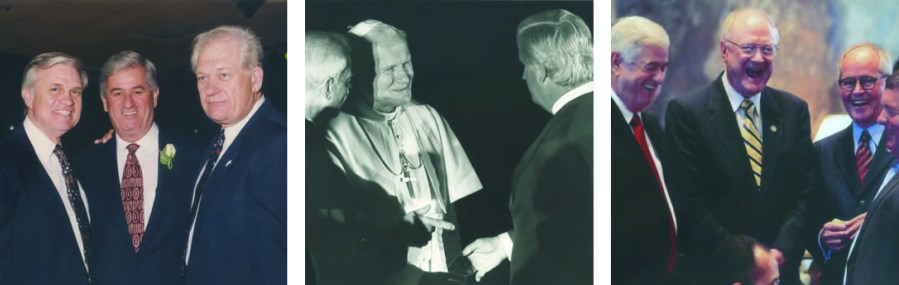
The best company came when he was invited to greet Pope John Paul II at the airport in 1987. “Speaking directly with him was by far the highlight of my 45 years of public service,” he said.

His strong Catholic faith keeps him centered, he said. And he remains grateful for the faith his constituents have placed in him for so many years.

“It may not always appear that a certain vote on its face value is in the best interest of those back home, but they trust me that there’s a bigger picture or a piece of the puzzle that has to be placed,” he said. “And, of course, I have made my share of mistakes, too. And they have forgiven me for those. I am forever thankful for all their support.”

It’s a reciprocal relationship. Alario has enjoyed their support and his constituents have enjoyed the fruits of having the most senior member of the Legislature hail from their hometown. Over the years his districts have been speckled with construction and projects that add up to more than $1 billion.

With more than 435,000 residents now living and working in Jefferson Parish, it looks quite a bit different than it did when there was no environmental regulation and the Robinson Can Company, known for its canned shrimp product, would dump its remnant seafood hulls directly in the bayou adjacent to its property. It stunk. It really, really stunk, he said.

That stink is what motivated Alario to first run for public office. But first, he had to navigate newly drawn districts that resulted from the Civil Rights movement of the 1960s and the Voting Rights Act, passed in 1965. In 1972 Louisiana replaced at-large seats with single-member Legislative seats. Previously Jefferson Parish had elected six at-large members of the House of Representatives. Drawing geographic district boundaries insured that for the first time ever some members would have to come from the West Bank. Initially Westwego was split in two different districts, but a court declared that the political districts be re-drawn in order that Westwego could remain whole. Once his hometown was contained within a single district, Alario threw his hat in the ring. He promised voters that he would find a way to stop the stink that was keeping additional economic development at bay.

He won and he kept his word. He was able to secure state funding for a pipeline that ran from the seafood processing plant to the Mississippi River. The company got to continue canning shrimp, the discharge was now flowing into the Gulf where it became food in the ecosystem, and, most importantly, the stink was gone and economic development commenced. It was a win for everyone. And, it was the first of many to come.
SLU010 FALL-2016-Inside-HR.indd

DECADES OF CHANGE
He associates sports with the votes he is most proud to have cast—those repealing Jim Crow laws in Louisiana. He remembers his first encounter with segregation when he went to play ball on the East Bank one time.

“In the neighborhood, we played sports outside all day, and would cup our hands to drink from a faucet when we got thirsty,” he said. “But we went to play once on the East Bank, and I clearly remember there being two drinking fountains. One was labeled ‘White’ and the other ‘Colored.’”

The ‘White’ fountain wasn’t working correctly so he and his friends drank from the ‘Colored’ fountain.

“It was wonderfully clear and pure water,” he said. It resonated with him that the water from both fountains was the same, and two separate fountains seemed silly.

Other transformations he’s witnessed entail technology and specifically its impact on media coverage of legislative action. Thanks to live streaming, video conferencing and even archived video recordings of committee meetings and legislative action in both chambers, journalists no longer must be physically present in order to report on the news of the day. However, he feels they should be present in order to more accurately and effectively do so.

“The cameras face toward us [the legislators] most of the time. People who aren’t there in person don’t get to see the body language or reactions of people in the audience or even of other legislators who aren’t in the frame all the time,” he said. “There is a lot lost. It can lead to things being reported without proper context.”

He added that there are still some who hold true to the higher journalistic standards and even some who still know how to properly use “those small reporter flip notepads.”
SLU010 FALL-2016-Inside-HR.indd

LOOKING FORWARD
There is fear that legislative decorum has lost a bit of its luster. The waning minutes of the First Legislative Special Session of 2016 stand out as one of the most telling of such statesmanship decline. Described as chaotic and embarrassing, the final minutes saw reams of documents and legislators flying back and forth from the Senate and House with legislation in order to meet the deadline for sine die—the closure of a legislative session as set by the Louisiana Constitution.

“We [the Senate] received seven or eight Conference Committee reports in the final seconds. If we wanted the funding to plug the budget hole, we had to vote without even reading the reports,” he said. “That’s not the way for a state to do business. It upset me greatly.”

He added that he feels members of the Legislature learned a great lesson that day, and that they have collectively moved forward in a manner more befitting an elected body of the Great State of Louisiana.

“Of course, nothing’s perfect,” he quipped. “Democracy is supposed to operate within rules. The problem is there is no 15-yard penalty for unsportsmanlike conduct in the Legislature.”

At 73 years old, Alario has spent more than half his lifetime as a team leader in the Legislature. He’s also been busy on the homefront. He and “his girl,” who was the motivation for weekend trips home from Southeastern, married and had four children. He became a widower in 2006 when his wife of 40 years, Ree, passed away after battling cancer. At present he is the proud grandfather of three boys and three girls—“a grandkid six-pack”—who range in age from nine-months-old to 18-year-old Allison, who is a freshman at Southeastern this fall majoring in kinesiology.

What advice would he give her and her fellow classmates?

“The world doesn’t owe you a whole lot. You can only earn respect through service,” he said. “Make sure you take some courses that give you a broad education so you can see the big picture. History is very important, so we can try to learn from the past, too.”

If you hope to one day run for office, he advises students to get involved in the local community so they can learn its various needs. “Volunteer at a Chamber [of Commerce] to learn about the business community’s needs. Be a volunteer fireman to find out about emergency response needs. Donate your time at a nursing home to find out what senior citizens need,” he added. “Oh, and don’t forget to study!”

Wise words from a true Lion of the Legislature.

Due to term limits that he helped pass, however, he is currently serving his final term as a State Senator.

“At this point I’m more concerned about the BIG term limit than any political term limit,” he said with a grin. “I had seven by-passes 18 years ago when I had a heart attack. The doctor tells me those usually last about 10 years. As best I can tell, I’m about eight years past my warranty right now.”

So what’s next?

He says he’s leaving his options open.

“Three years is a LONG TIME when it comes to politics,” he said.

He could run for the House of Representatives again in 2020. He could retire and relax. He could also retire and go back to school.

Really? Back to school?

“Yes, I need to see if any of my old credits would still apply toward another degree,” he said with a smile. “I may very well go to Southeastern again and make more friends.”

At Southeastern’s Fall Commencement in December, 2016, Senator Alario was presented with the Southeastern Louisiana University Lifetime Achievement Award.

By Erin Moore Cowser. Originally published fall 2016 in the Southeastern Magazine.

Download the full article here.

Free for Alumni: Cloud Foundations Course

The Southeastern Alumni Association, along with the College of Science and Technology through its Workforce Talent Initiative, is offering a unique professional development opportunity for Southeastern graduates. This offering allows Southeastern alumni access to a free program that provides a direct pathway to receive an Amazon Web Services (AWS) certification.

The AWS Academy Cloud Foundations Course provides a detailed overview of cloud concepts and AWS core services, security, architecture, pricing, and support. This course is designed to be delivered over 20 hours, and it prepares students to pursue becoming an AWS Certified Cloud Practitioner.

There is no cost for Southeastern alumni to participate in this online-based course.

Instructor led sessions will be conducted virtually and will begin on June 14.  For more information, or to register for this course, contact Workforce Talent Initiative Student Success Specialist Dakota Bankston at Dakota.Bankston@southeastern.edu.

To learn more about Amazon Web Services, click here.

Seeking Artifacts for the Centennial Women’s Suffrage Project

A group of Southeastern Louisiana University professors and volunteers is planning events and exhibits in celebration of the 100th anniversary of ratification of the 19th Amendment in Louisiana. The amendment granted American women the right to vote, a right known as women’s suffrage, and was ratified on August 18, 1920, ending almost a century of protest.

The Centennial Women’s Suffrage Project is seeking artifacts from women who participated in the women’s suffrage movement in Louisiana. The group is interested in items such as letters, photos, old newspaper clippings, suffrage sashes, copies of speeches, pins or anything a female relative may have left in commemoration of participation in the movement, said Southeastern’s Sims Memorial Library Head of Access Services Angela Dunnington.

“The artifacts will be placed in a temporary display at Sims Library on Southeastern’s campus and may become part of an exhibit that will travel to museums and libraries around the state beginning in 2020. All items will be preserved and returned, if the donor so desires,” Dunnington explained. “An object label will specify the history of the artifact and its donor.”

To donate or loan an artifact, contact Dunnington at angela.dunnington@southeastern.edu or Assistant Professor of History Samantha Cavell at samantha.cavell@southeastern.edu.

Night Out: Northlake Community Band at Pottle Auditorium

Southeastern Louisiana University will present the Northlake Community Band in concert Tuesday, May 14, at 7:30 p.m., in Pottle Auditorium on Southeastern’s campus. Titled “Marching in the Academic Procession,” the concert is free and open to the public.

Conducted by Jerry Voorhees, the concert will feature works by J. P. Sousa, A. Alvarez, J. Brahms, Andrew Lloyd Webber, G. F. Handel and others.

The Northlake Community Band consists of musicians from high school students through retired professionals and always welcomes new members.

For more information, contact the Community Music School at cms@southeastern.edu or at 985.549.5502.

Blackened Brew and The Cakery Voted Tasters’ Choice at Chefs Evening

Attendees at Southeastern Louisiana University’s 35th annual Chefs Evening, held March 31, chose Blackened Brew and The Cakery by popular vote for the event’s Tasters’ Choice Awards. Patrons sampled cuisine from nearly two dozen restaurants and caterers before casting their votes.

The Cakery, based out of Tickfaw, won in the Best Dessert category for its four signature cakes. Downtown Hammond gastropub Blackened Brew came in first in the Best Entrée category for its seared sesame tuna on a fried wonton with a wasabi crème fraiche and teriyaki honey drizzle.

Chefs Evening is organized by the Southeastern Foundation and serves as the organization’s main fundraising event with all proceeds directly supporting student scholarships and academic programs. In addition to offering tastings of food and drink from around the region, Chefs Evening features a silent auction, a live auction, and raffles. The 2019 Chefs Evening had an attendance of over 525 and raised more than $130,000 for the University and its students.


Chef's evening
Above image: Representatives from Blackened Brew, located in Downtown Hammond, prepare to serve patrons at the 35th annual Chefs Evening. Header image: Selections from The Cakery at the 35th annual Chefs Evening.

Ben Nevers to Receive Honorary Doctorate at Spring Commencement

Former Louisiana House and Senate member Ben Nevers will be honored with a Southeastern Louisiana University Honorary Doctor of Humanities degree as part of the university’s commencement ceremonies at 10 a.m. Saturday, May 18, at the University Center.

That morning the university will confer more than 1,000 degrees on students who are graduating with bachelor’s, master’s and doctoral degrees.

“As a stalwart proponent of education throughout more than two decades of public service, Ben Nevers truly deserves this recognition, which is one of the highest honors the university can bestow,” said Southeastern President John L. Crain. “Education at all levels in Louisiana has benefitted from his unwavering dedication.”

Nevers was a Democratic member of the Louisiana Legislature, serving in both the House of Representatives and Senate, from 1999 until 2016, at which time he accepted Governor John Bel Edwards’ invitation to serve as chief of staff. One of Nevers’ primary roles while serving as chief of staff was coordinating the state’s response to record levels of flooding in 2016. During his time at the Capitol, Nevers cultivated a reputation as a legislator respected by members of both parties.

A US Army veteran, he was previously a member of the Bogalusa School Board. He also served as the president and CEO of Nevers Electrical and Contracting, a company he founded in 1980.

Nevers, who represented Louisiana’s District 12, was first elected to the Senate in 2003 after having served five years in the House of Representatives. A former member of the Northshore Legislative Delegation, his district covered areas in St. Tammany, Washington and Tangipahoa parishes, including Southeastern.

Education was a cornerstone issue of his Legislative tenure. As head of the Senate Education Committee and chairman of the Postsecondary Education Review Commission, Nevers championed the importance of education in Louisiana.

He served as a member of various statewide educational committees, including the Louisiana Tuition Trust Authority, the Louisiana High School Redesign Commission, and the Blue Ribbon Commission for Educational Excellence.

Over the years, Nevers has served with several non-profit organizations that reflect his interests in agriculture, economic development, education, health care and infrastructure. He is a former president of the United Way, served on the executive board for the Istrouma Area Council of the Boy Scouts of America, the St. Tammany Right to Life Association, the Louisiana Farm Bureau, the Louisiana and Washington Parish Cattleman’s associations and Washington Parish Forestry Landowners Association.

Nevers is the recipient of numerous awards, including the 2015 Mondale-Brooke Award for Fair Housing Leadership and Civic Participation and the 2016 Russell B. Long Legislative Service Award. In addition, he is a 2017 American Federation of Labor and Congress of Industrial Organizations Hall of Fame Inductee. He has also been recognized with the President’s Award from the Louisiana School Psychological Association, the Louisiana School Board Association’s Legislator of the Year Award, and several awards from Louisiana Family Forum.

KSLU Student Newscaster Wins Multiple AP Awards

A Southeastern Louisiana University student has been recognized by the Louisiana-Mississippi Associated Press. KSLU newscaster and on-air host Connor Ferrill of Mandeville won first place in the Radio Newscast category at the Louisiana-Mississippi Associated Press Broadcasters and Media Editors college contest.

Ferrill also brought home second place in the Radio Reporter category and received Best of Show at the recent awards banquet in Jackson, Miss. A senior communication major, Ferrill has worked at KSLU for two years.

“We’re proud of Connor and what he’s accomplished,” said KSLU General Manager Todd Delaney. “We strive to create an atmosphere of professionalism and provide real-world experience to train tomorrow’s broadcast leaders today. Connor is a top-notch journalist who has all of the traits of a seasoned professional. I’m certain he’ll be highly successful in all of his future ventures and make Southeastern proud of his future accomplishments.”

As Southeastern’s public access radio channel, KSLU 90.9FM offers a wide variety of programming, including music and live broadcasts of sporting events, the award-winning and syndicated “Rock School” radio show, and the community talk show “Point of View.” Named the No. 1 college radio station in the region by the Southeast Journalism Conference, KSLU provides Southeastern students interested in broadcasting with an intensive learning environment.

For more information visit www.kslu.org.

Increasing STEM Awareness with New Mobile Lab

Area students now have the opportunity to feed their minds with hands-on STEM (Science, Technology, Engineering and Math) activities through a new “vehicle.” The Tangi STEM Coalition, of which Southeastern Louisiana University is a member, developed the “Brain Food Truck,” or mobile STEM lab, to increase accessibility to STEM activities for youth in underserved communities.

Areas to be served by the new mobile STEM lab include Livingston, St. Helena, Tangipahoa, Washington, and St. Tammany parishes, said Southeastern Assistant Director of Math Science Upward Bound high school program and project co-chair Wendy Conarro. The purpose of the truck, she said, is to present enriching STEM activities by providing content for summer camps, after school and Saturday programs.

“Thanks to the dedication of many volunteers and donors, the Brain Food Truck was introduced to the public at the 2019 Ponchatoula Strawberry Festival, where Hammond High Torbotics Team members took a break from preparing for World Competitions in Houston to serve up STEM activities to families,” she said. “On the menu were Strawberry DNA extraction, building and testing magnetometers and Keva Plank contraptions, commanding a Dashbot, and creating paper circuit art.”

To help supply the Brain Food Truck, Southeastern Instructor of Industrial Technology Ed Rode led a work group of student volunteers during Southeastern’s The Big Event to assemble shelving to store supplies for over 40 STEM activities.

“We would not be this far along without the expertise of partners such as Mr. Rode who took the lead in assembling the intricately designed shelving provided to our project by the Nebraska Children’s Foundation, which has 20 such trailers rolling through their rural communities.”

The Brain Food Truck was funded by United Way of Southeast Louisiana, Intralox/Laitram, and Ponchatoula Kiwanis in honor of late engineer, Lee West. The project was also made possible by dozens of volunteers and hundreds of volunteer hours over the past nine months, Conarro said.

“Events such as the Strawberry Festival and the upcoming Hammond Community STEM Cafe will give us time to test the system while also providing enriching activities at a few local events,” said Troy Williams, project co-chair. “Ultimately, the Brain Food Truck will bring tested, standards-based, student-centered activities to communities who lack such opportunities.”

Conarro said the Brain Food Truck is being piloted this summer, after which they plan to secure funding for a fleet of mobile STEM labs to serve the Northshore region.

For more information or to make a reservation for the Brain Food Truck, visit www.brainfoodtruck.org. Priority will be given to communities currently without summer STEM enrichment opportunities, Conarro said.

Nursing School of the Year for Advanced Practice

The Southeastern Louisiana University Doctor of Nursing Practice Program has been recognized by the Louisiana Nurses Foundation as the Nursing School of the Year in Advanced Practice. The award recognizes a school of nursing offering formal education for registered nurses seeking a graduate degree for advanced clinical practice roles, as well as nursing administration, nursing education and research.

This is the second time Southeastern has been recognized with a Nightingale Award for an advance practice program, with the master’s program being recognized as program of the year in 2013. Also, Southeastern’s undergraduate nursing program has been recognized with the Nightingale Award three times.

The competition is evaluated by a panel of out-of-state judges who review the nominations submitted by nursing programs throughout the state. The Nightingale Awards are the foundation’s highest recognition for quality, service, commitment and excellence among Louisiana registered nurses.

Ann Carruth, dean of the College of Nursing and Health Sciences, said nursing programs are evaluated for the award by a wide range of criteria, including accreditation status, innovations in education and teaching, nursing examination passage rate, and comments solicited from graduates, faculty and area employers.

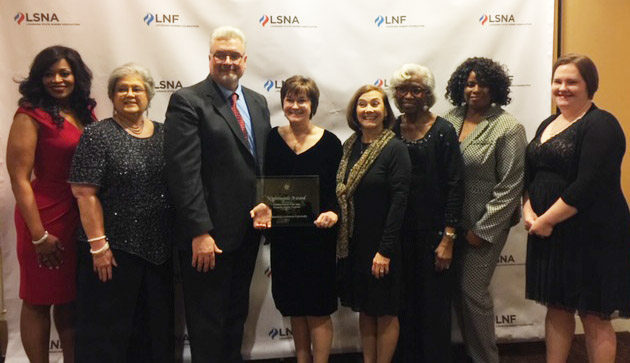
nursing_nightingale
Above image, from left: Instructor of Nursing Lana Auzenne, Associate Professor of Nursing Donna Coffey, School of Nursing Department Head Ken Tillman, Dean of the College of Nursing and Health Sciences Ann Carruth, Associate Professor of Nursing Eileen Creel, retired Professor of Nursing Lorinda Sealey, Assistant Professor of Nursing Del Mars, and Southeastern nursing alumna Heidi Roshto

Southeastern’s program is an academic partnership between Southeastern and the University of Louisiana at Lafayette that offers Doctor of Nursing Practice degrees. The partnership allows Southeastern and UL Lafayette the opportunity to provide stand-alone, but mutually supportive DNP programs to leverage teaching and learning resources, Carruth explained. Building on the strengths of its Commission on Collegiate Nursing Education accredited baccalaureate and master’s programs, Southeastern offers a post-masters DNP program seeking qualified advanced practice nurses and nurse executives.

“I am very proud of our DNP program. Students who are administrators and advanced practitioners create a two year-long project, partnering with an organization to implement policy, evaluate quality, translate research and best evidence. These projects require tremendous organizational commitment and multidisciplinary team effort,” Carruth said.

“In the end, students document data-driven analysis and evaluation of the project. We’ve had five cohorts graduate from our program. They have impacted health care throughout southeast Louisiana and beyond. It is an honor to be a dean working with such talented, dedicated faculty and students.”

The nursing school also operates a completely online RN to BS degree program that allows registered nurses with an associate’s degree or nursing diploma to complete courses leading to a bachelor of science degree.