New students attending an official on-campus visit at Southeastern will have the admission application fee waived through May 1, university officials recently announced. As the university has scheduled many recruitment events for fall and spring, students attending a Lion Pride Preview or a campus tour can take advantage of the benefit.
Director of Admissions Anthony Ranatza said Lion Pride Preview offers prospective students and their guests an opportunity to explore academic options and learn about campus life, while also enjoying a complimentary lunch at Southeastern’s premier restaurant, the Mane Dish. Students can register for the next Lion Pride Preview scheduled Friday, Nov. 19, by visiting southeastern.edu/visit.
“We invite students and parents to visit Southeastern and enjoy a day on our beautiful campus,” said Ranatza. “We are excited to be able to again offer these on-campus experiences for students and their families, especially with our signature recruitment event, Lion Pride Preview.”
Southeastern recently announced a new admissions opportunity called “Fast Track,” in which the university expanded its test-flexible approach. High school students with a minimum 2.50 GPA are automatically admissible with criteria for fall 2022. More information on Fast Track is available at southeastern.edu/fasttrack.
“High school seniors should apply now to Southeastern for summer and fall of 2022,” said Ranatza. “We’ve made that process easier by removing barriers. Combining free applications with visit opportunities and simplifying our admission criteria is a total commitment to our caring approach, which continues to set Southeastern apart.”
Future students are encouraged to apply before the priority deadline of Jan. 15 to qualify for higher scholarship offerings. Learn more information and apply for admission at southeastern.edu/applynow.
In an effort to simplify the admission process and provide the quickest path to beginning a college career, Southeastern has taken recent steps to ensure that prospective students can more easily become new students.
Southeastern recently announced a new admissions opportunity called “Fast Track,” in which the University expanded its test-flexible approach. High school students with a minimum 2.50 GPA will be automatically admitted for Fall 2022.
This innovative approach allows students certainty of admittance before taking standardized tests.
“We wanted to provide high school students an easier path to admission, especially for those who are already demonstrating success at the high school level. National statistics on college success rates show that success in high school is a strong predictor of success in college,” said Anthony Ranatza, director of admissions.
More information on Fast Track can be found at southeastern.edu/fasttrack.
Southeastern also announced that through May 1, any new student attending an official on-campus visit will have the admission application fee waived. As the University has scheduled many recruitment events for fall and spring, students attending a Lion Pride Preview or a campus tour can take advantage of this benefit, reducing their cost of applying to zero.
Lion Pride Preview offers prospective students and their guests an opportunity to explore academic options and learn about campus life, while also enjoying a complimentary lunch at Southeastern’s premier restaurant, the Mane Dish. Students can register for the next Lion Pride Preview by visiting southeastern.edu/visit.
“Students who come to campus for a personal tour fall in love with Southeastern. By connecting a tour to a no-cost application, we again are innovating to ensure that students have the easiest path to begin their college career here,” added Ranatza.
“We invite students and parents to visit Southeastern and enjoy a day on our beautiful campus,” he continued. “We are excited to be able to again offer these on-campus experiences for students and their families, especially with our signature recruitment event, Lion Pride Preview.”
“Southeastern has made the admission process easier by removing barriers. Combining free applications with visit opportunities and simplifying our admission criteria is a total commitment to our caring approach, which continues to set Southeastern apart.”
Future students are encouraged to apply before the priority deadline of January 15 to qualify for higher scholarship offerings. Learn more information and apply for admission at southeastern.edu/applynow.
The Department of Visual Art + Design will host a photography exhibit by three artists—Jeremiah Ariaz, Jill Frank, and L. Kasimu Harris—titled Vanishing Black Bars, Celestials, + Louisiana Trail Riders at the University’s Contemporary Art Gallery, located at 100 East Strawberry Stadium.
The exhibition is free and open to the public until Nov. 15. Contemporary Art Gallery hours are Monday, Tuesday, and Thursday from 8 a.m. to 5 p.m. with extended hours until 8 p.m. on Wednesdays, and Friday 8 a.m. to 12 p.m.
Works featured in the exhibition demonstrate the artists’ shared interest in documenting Southern communities that may often go unseen or undocumented, said Gallery Director Cristina Molina.
“On view are series by L. Kasimu Harris, who has created an index of once prevalent but now disappearing Black bars and lounges in New Orleans and the patrons who commune and celebrate in these spaces,” Molina explained. “Jeremiah Ariaz shares monochromatic images of the Black trail riding clubs in Southwest Louisiana, a subculture that is rich in history and activity, but one that remains largely unknown. And Jill Frank exhibits large scale images and video of youth culture with all of its adolescent growing pains.”
Ariaz was raised in Kansas and is now a professor of art at Louisiana State University. He received his BFA from the Kansas City Art Institute and MFA from the State University in New York at Buffalo. His artworks explore the West as both a physical space and a terrain for the imagination, Molina said. For his most recently completed project Louisiana Trail Riders, he was the recipient of a 2018 ATLAS grant, the Michael P. Smith Award for Documentary Photography from the Louisiana Endowment for the Humanities, and the Southern Arts Finalist Prize from South Arts, as well as being named the 2018 Louisiana State Fellow.
Frank lives in Atlanta and teaches photography at Georgia State University. She studied photography at Bard College and received an MFA from The School of the Art Institute of Chicago. Her work has been shown nationally and internationally and featured in Art Papers. Selected solo exhibitions include the Museum of Contemporary Art, Georgia and the Museum of Contemporary Art, Chicago. Reviews of her work have appeared in Art Forum, The Paris Review, and Bad at Sports.
Harris is a New Orleans based artist whose practice deposits a number of different strategic and conceptual devices in order to push narratives, and he strives to tell stories of underrepresented communities in New Orleans and beyond, Molina explained. Harris has shown in numerous group exhibitions across the US and two international exhibitions and has had six solo photography exhibitions. Last year he was among 60 artists selected nationwide for State of the Art 2020 at Crystal Bridges Museum of American Art and had a solo exhibition at the August Wilson African American Cultural Center in Pittsburg.
Southeastern student Darian Boesch hasmastered the formula for combining his business education and passion for speed—becoming an NHRA World Champion.
Darian Boesch
From video or pick-up games to art, yoga, or getting lost in the great outdoors, most students have a hobby, a way to unwind and recharge at the end of a long day or week. But Southeastern senior and Ponchatoula resident Darian Boesch has accelerated his hobby to another level.
Outside of his studies, Darian channels his time and energy into racecar driving. At the National Hot Rod Association (NHRA) Finals held in Las Vegas this past fall, engines and spectators roared as Darian tore across the finish line in his carbon fiber Jerry Haas Camaro SS to become the NHRA World Champion in the Top Sportsman category. This would be an epic achievement for anyone, but for someone only 21 years old and a fulltime college student it’s even rarer.
“For me, it’s the biggest thing you can do in racing,” Darian said of the competition. “Everybody shoots for the world championship. Whether it’s Formula-1, NASCAR, or any other kind of competition, you want to have a world championship and have that big ‘#1’ on everything.”
Racing is in Darian’s blood. His dad, Mario Boesch, began racing when he was close to Darian’s age and introduced him to the sport. Darian began competing in Jr. Dragsters when he was 7, earning 18 championships in that category alone.
Darian and his father, Mario Boesch
“Pretty much my earliest memory is in the shop,” said Darian. “One of our cars was in there, and my dad had just put the motor back in. He fired it up and actually let me crack the throttle a couple of times, so I got to hear the motor rev up… And from there I have not looked back.”
While Darian is mainly the one behind the wheel while on the track, his family is part of his secret weapon for success. In honor of this, their self-funded team is named MKD (Mario, Karen, and Darian) Racing. Mario, a New Orleans business owner who also still occasionally competes with the team, pitches in with tuning the cars and driving the team trailer to all of the events, most of which are at least nine hours away. Since weather plays a significant role in how the cars run, one of Karen’s biggest roles is managing the computer weather acquisitions. “A five-degree temperature difference, or the humidity or density altitude, makes a big difference,” said Darian.
And as for Darian, racing takes much more than just jumping in the car, and for vehicles to be pushed hard and continue to perform at such a top level they take a lot of maintenance. While the fabrication, painting, and motor and transmission assembly are outsourced to professionals, putting the cars together and preparing them for racing on a weekly basis is mostly up to Darian—whether it’s changing out motors, fluids, or various parts and pieces at his home racing garages.
MKD Racing owns and maintains a total of six competition vehicles, including four dragsters, the Camaro, and a Top Sportsman S-10 truck/grudge car.
Darian has reached 235 mph in the dragster and 230 in the Camaro, but in NHRA, there is also much more to being behind the wheel than crossing the finish line the fastest. Competitors must set a predicted finish time and come in as close to it as possible, and if they cross faster than it they lose.
“To do that I’m not actually looking down the track,” explained Darian. “I’m looking at my opponent the whole way. You want to make the race as close as possible. You can use the gas pedal, the brake pedal, the parachutes—anything to get as close as possible without going too fast. Generally my car can go about 230 mph, but I usually cross the finish line at about 205-210 because I’m killing so much ET (elapsed time) to go slower. A lot of times I’ll get to the finish line a foot or two in front of my opponent, which is hard to get that close at 230 mph.”
“Basically, it’s like a 200-mile-per-hour chess match,” he said. “They’re making moves. You’re making moves. It’s all about who can outsmart the other one going that fast. And you have 6 seconds to figure it out.”
Darian and his parents regularly travel together across the country for races, whether it’s Florida, the Carolinas, Texas, Kansas, Missouri, Nevada, or everything in between. Doing this and preparing the cars—in addition to working for his family’s business—takes a lot of time, but Darian remains on track to graduate in December 2021.
Along with learning how to fine-tune his time-management skills, Darian noted that the support from his professors has been instrumental in helping him to academically succeed. Not only have they been helpful in working with him if he needs to miss a class or turn in an assignment or test early due to travel for a competition, he said that most actually get excited when they learn of his level of racing, even before the National Championship win. Their personal support and the proximity of campus to his home garages have allowed him to pursue his dream of racing, not to mention becoming a national champion, while earning a quality education.
He has also been able to translate what he has learned in his studies into his racing career. “My business administration major has made me think about how to make things function a little bit better,” said Darian. “Some of my management classes, for example, have taught me how to make things run smoother and to cut out parts you don’t need, which has really helped a lot, not just in terms of getting things done better with racing, but also with work. Every little extra you can cut off that will save you time or money helps; it’s so much work, you need every little bit you can get. There’s definitely a lot that I can apply from my classes into this.”
As for work and the future, Darian plans on taking on more with his father’s company when he graduates, eventually running it. But he is far from done with racing. With one World Championship under his belt, he is revved up to keep firing for more, such as winning the World Championship in two different cars in the same year.
“I have a very long future ahead of me in this,” he said.
Southeastern was home to alumnus James “Jim” McClimans (class of ’58) from a very young age, and it remained a place to which he contributed and supported throughout his life.
Jay McClimans
Jim was the son of Dr. Jay W. McClimans and Martha Orr McClimans, who raised their family in Hammond down the street from Southeastern’s beautiful campus. In 1942, Jay began serving as a mathematics professor at Southeastern. He eventually became the University’s first department head of mathematics.
“Our entire family went to athletic and cultural events at the college,” Jim once said, reflecting on his childhood memories with his sister Mary Lee McClimans Bass.
When he moved to Hammond as a young child, Jim began his journey at Southeastern’s Laboratory School in second grade. He continued his education on Southeastern’s campus, attending Southeastern High School and graduating in 1953. This all happened within the same hallways as what is now McClimans Hall, which was at that time the education building.
After graduating high school, he continued to pursue his education by studying engineering at both Texas A&M and LSU and building his work experience with Chance Vaught Aircraft. In 1956, he returned home to Southeastern and, following his father’s passion, majored in mathematics. In 1958, Jim graduated with a bachelor of science in mathematics and a minor in physics.
After graduating from Southeastern, Jim began his career at Shell Oil Company as a geophysicist, gaining experience with the oil and gas company. He traveled around the world managing projects for Shell Oil Company and became the manager of Geophysics Research at Shell Development Company. This led him back to Louisiana, working as the chief geophysicist of the Southeast region.
Jim McClimans
Jim had many career achievements, including record Shell Exploration and Production Company profits from the Michigan Play in the 1970s, significant commercial discoveries in Cameroon and Syria, and in 1989 record Shell (U.S.) discoveries in the deep water Gulf.
On July 24, 1981, Jay W. McClimans Hall was dedicated in honor of his father Jay’s commitment to education and support of the mathematics program.
Jim carried on his parents’ love and support of Southeastern throughout his life, making his own mark by giving back to the university that helped set him on a path to lifelong success and breaking down financial barriers for current and future generations. Over the years he positively impacted the lives of countless students through his philanthropy. Leaving a Legacy
Southeastern named Jim the Distinguished Alumnus of the College of Science and Technology in 2006 in recognition of his success and contributions to the community. He established significant endowments in STEM, including support for the University’s Mathematics Department to continue to honor his father’s legacy.
About his support for Southeastern, Jim previously said, “Marilyn [my wife] and I initiated this gift to Southeastern in the form of retirement fund assets as a way to honor my father. It is a symbol of the love my family has for this fine institution.”
Jim passed away July 15, 2020, but many can learn from his example of hard work, dedication, and giving back to the community that helped shape his future.
“Sharing a friendship with Jim was one of the greatest blessings of my career,” said Vice President of University Advancement Wendy Lauderdale. “His devotion and commitment to Southeastern was evident in every initiative he supported. He will be greatly missed.”
The McClimans’ legacy will live on, especially through the ongoing learning within McClimans Hall across from historic Friendship Circle.
Southeastern’s Information Technology program has been ranked in the top 100 in the nation for affordability according to UniversityHQ. The organization provides students with the necessary resources to prepare and plan their career paths in their chosen fields and strives to present an objective, unbiased view of colleges so that students can set reasonable expectations and discover outstanding schools.
The only university in Louisiana included, Southeastern’s program was ranked 59th in the nation. With 500+ students and an enrollment that has more than doubled over the past decade, Southeastern’s Computer Science and Information Technology programs are recognized as leaders among and as two of the state’s fastest-growing computing and information technology programs.
“We are immensely proud of the Information Technology program,” said John Burris, Computer Science department head. “This ranking took into account Southeastern’s low tuition cost combined with factors such as retention and graduation rates. However, with information technology graduates having an average starting salary over $50,000, the program is more than just affordable, it is a great investment.”
Southeastern’s programs offer concentrations with an emphasis on scientific computing, business, and data science, as well as a master’s degree in integrated science and technology with computer science and data science areas of study. The program also provides opportunities to connect with faculty for undergraduate research.
To gather data, UniversityHQ uses government sources, which are unbiased, consistent, and reliable. Each college in the rankings is assessed using the same data sources so that the comparisons are all even and consistent.
The criteria for ranking included cost of tuition, admission rate, retention rate, graduation rate, graduating salary, number of programs offered, online programs offered, loan default rate, diplomas awarded, and percentage of students receiving financial aid.
For more information about the Computer Science and Information Technology programs, emailcs@southeastern.eduor call 985-549-5740.
During a recent high school counselor workshop, Southeastern announced a new admissions opportunity for first-time students called “Fast Track.” Beginning in the fall of 2022, high school students with a minimum 2.50 GPA will be automatically admissible to the university through Fast Track. As an expansion of the university’s test-flexible approach, ACT scores will not be required for admission.
For Southeastern, test-flexible refers to the types of test scores accepted for English and math placement, including Accuplacer, ALEKS, ACT, Pre-ACT, PSAT, SAT, and LEAP. Meeting eligibility requirements for TOPS and institutional scholarships at Southeastern will still require ACT/SAT scores.
“As a leader in higher education, we are committed to serving the needs of our region by providing access to an outstanding post-secondary education and college experience,” said President John L. Crain. “Fast Track will allow us to provide earlier admission decisions for students, be flexible in using multiple potential measures to place them in appropriate courses of study and shepherd their success through academic support systems, including academic skill-building coursework and corequisite models for math and English when appropriate.”
While the existing admission criteria for the university remains in place, the additional option of admitting based solely on the high school GPA allows for greater student opportunities and aligns with the mission of Southeastern, said Director of Admissions Anthony Ranatza.
“As the pandemic continues to disrupt some of the traditional admissions processes, such as securing ACT or SAT scores, Fast Track will allow Southeastern to provide faster admission decisions without having to rely on these scores,” Ranatza explained.
St. Scholastica Academy College Career Advisor Caroline Capps was delighted to hear about the program.
“As an alumna of such an innovative university,” said Capps, “I am excited to learn that Southeastern continues to seek out unique and creative ways to provide opportunities for students.”
Southeastern has reinvented its visual identity with the creation of new logos for both the University and athletics. The change comes as the University approaches its 100th anniversary in 2025.
“Since its opening in 1925, Southeastern has had a long and storied history of empowering generations of students to reach for and achieve their best future,” said Southeastern President John L. Crain. “As we are in the final years of our first century and beginning to envision our second century, the time has come to update and unify the University’s brand and identity.”
Drawing from iconic elements of Southeastern’s identity, campus, and heritage, the new logos bridge Southeastern’s history and future, Crain said.
“Logos should reflect our character, strengths, excellence and values. These new logos do just that,” added Crain. “The logo change is merely the beginning of a process to give Southeastern a modern brand identity that will lead us into the centennial anniversary.”
THE SOUTHEASTERN VERTEBRATE MUSEUM IS GROWING, CURATING, DIGITIZING, AND SHARING ITS COLLECTION TO ENHANCE ICHTHYOLOGY AND HERPETOLOGY RESEARCH.
The National Science Foundation has awarded a Southeastern specialist in the diversity of fishes a grant of $409,200.
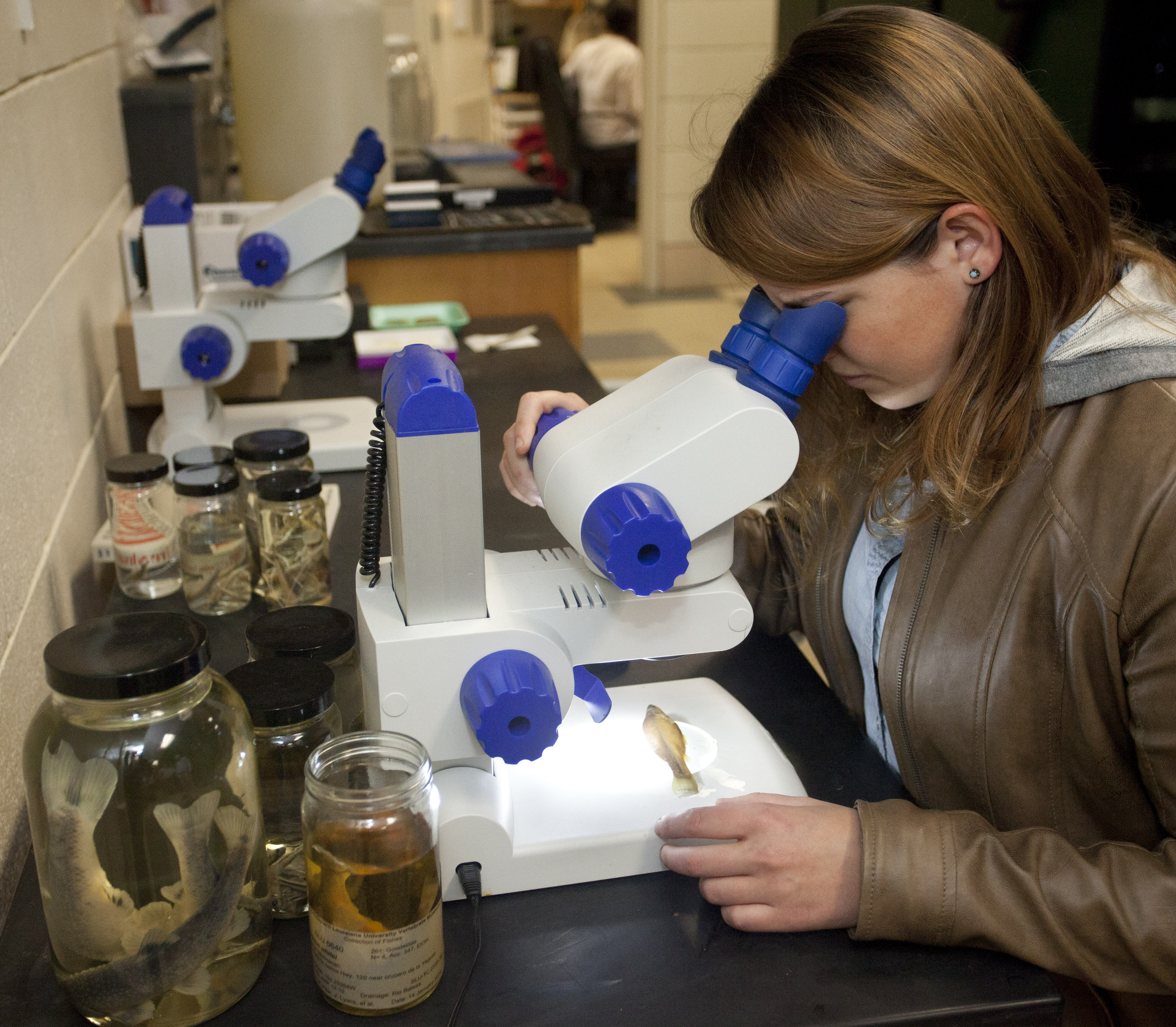
Professor of Biological Sciences and ichthyologist Kyle Piller received the three-year grant to improve the Southeastern Vertebrate Museum. The project will focus on curation of existing museum specimens and tissue samples, digitize and georeference specimen data, and integrate the data with online repositories, making the data available to the general scientific community.
Kyle Piller
“Southeastern has an Ichthyology and Herpetology collection that initially was developed for teaching and research in the 1950s,” said Piller. “The bulk of the collection is comprised of fishes—more than 120,000 specimens and over 7,000 tissue samples—with the majority of the specimens from the Lake Pontchartrain Basin in southeast Louisiana and, more recently, from throughout Mexico and Central America. We also have an ever-growing herpetology collection, part of which was recently obtained from the orphaned Tulane University herpetology collection.”
In addition to the reptile, amphibian, and fish collection, Piller said the museum also has birds and mammals, although their numbers are much smaller. Specimens in the collection include sea turtle shells, a whale vertebrate, and alligators.
“We actually have alligator purses and shoes to show our guests what is done with alligator skins once they are harvested,” Piller said. “We have a whooping crane, which is hard to come by, and a couple of toucans that are mounted. We are slowly growing in all areas, but the fish collection has grown the most because that’s what I study.”
College of Science and Technology Dean Daniel McCarthy said the grant will be transformative for the Ichthyology and Herpetology collection at Southeastern.
“The museum is much more than a collection of jars to look at; rather, it contains a record of the reptiles and fishes from our region from decades ago, which will prove to be an invaluable resource to scientists studying this ecosystem,” he explained. “Furthermore, the educational outreach component of the grant will expose thousands of students to the importance of reptiles, amphibians, and fish to the Gulf Coast.”
Both undergraduate and graduate students use the specimens in the museum for research and study as part of undergraduate honors and graduate theses. Many students, Piller said, use the specimens to study their diets.
“Students can cut open the belly of a 20- or 30-year-old specimen and see what the species was eating back then versus what they are eating now,” he explained. “It also gives us a record of the presence of species now versus what they were 30 or 40 years ago, so we can look at change in communities in our region.”
Piller said the project will help revitalize interest in the natural world by using natural history collections to highlight the unique organismal diversity in Louisiana and beyond. Southeastern personnel will develop a traveling fish, reptile, and amphibian program titled “The Bone Sheaux.”
“This outreach program will be used to stimulate interest in organismal biology for K-12 students in southeastern Louisiana, which includes some of the most impoverished parishes in Louisiana,” he said. “A permanent loan will also be made available to Southeastern’s field station, Turtle Cove, which hosts more than 3,000 visitors annually for public outreach and teacher training workshops.”
“Although the bulk of the vertebrate museum is comprised of fishes, with five herpetology researchoriented faculty on staff and herpetology oriented graduate students in the department, the herpetology collection will continue to grow in the coming years, as our specimen growth primarily has been a by-product of ongoing research and thesis projects, as well as for specimen usage in the classroom,” he explained.
Piller said a natural history museum course will be developed for Southeastern’s undergraduate students to provide them training in museum curation and specimen preparation.
“This team-taught course will focus on collection care and curatorial techniques and will give students first-hand experience in a research collection,” he explained. “The course will culminate in the development of a museum website and a small working museum exhibit that will be displayed in the lobby of the biology building.”
Well-curated collections will continue to serve the scientific community for decades to come, Pillar said, and the value of scientific collections and data they contain are becoming increasingly important as major initiatives push the bounds and usefulness of museum data.
“Beyond hard-core science initiatives, natural history collections represent reservoirs of knowledge that need to be promoted and publicized to the general public,” he said. “Southeastern has specimens with scientific value, and this study will assure that these specimens are curated and available for study by the scientific community.”










 And as for Darian, racing takes much more than just jumping in the car, and for vehicles to be pushed hard and continue to perform at such a top level they take a lot of maintenance. While the fabrication, painting, and motor and transmission assembly are outsourced to professionals, putting the cars together and preparing them for racing on a weekly basis is mostly up to Darian—whether it’s changing out motors, fluids, or various parts and pieces at his home racing garages.
 Darian has reached 235 mph in the dragster and 230 in the Camaro, but in NHRA, there is also much more to being behind the wheel than crossing the finish line the fastest. Competitors must set a predicted finish time and come in as close to it as possible, and if they cross faster than it they lose.
 As for work and the future, Darian plans on taking on more with his father’s company when he graduates, eventually running it. But he is far from done with racing. With one World Championship under his belt, he is revved up to keep firing for more, such as winning the World Championship in two different cars in the same year.




 southeasternmonthly.blog